Animated American Traditional tattoo with AI
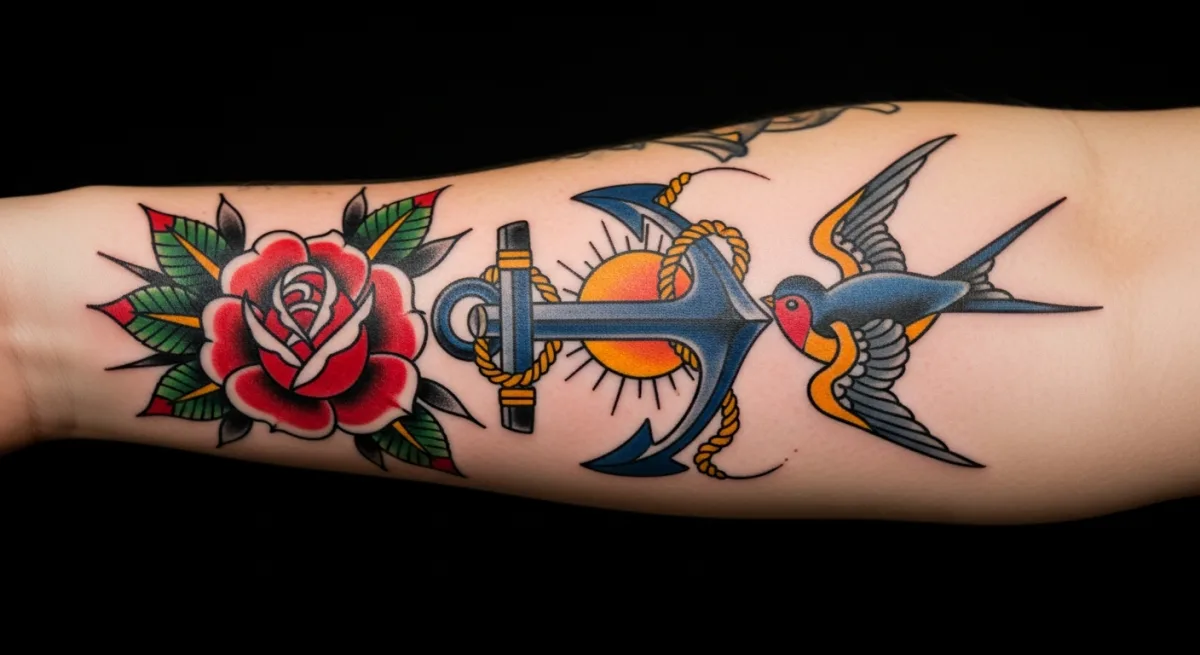
American Traditional is the DNA of modern Western tattooing, codified between the 1930s and 1960s by founding figures like Sailor Jerry Collins in Honolulu, then carried forward by Don Ed Hardy and Mike Malone. Born in military port cities, it was engineered to last fifty years without distorting: thick black outlines, restricted palette (red, yellow, green, blue), iconic motifs readable from ten feet away. Anchor, eagle, rose, panther, swallow, and clipper ship still compose its core vocabulary today. Animated with AI, the style shines through its graphic readability: every element stays perfectly defined even in fast motion.
Animated examples
Style characteristics
- Thick, consistent black outlines across the entire composition
- Strict palette: red, yellow, green, blue, sometimes purple
- Simple flat shading without complex gradients
- Iconic motifs rooted in American maritime and military culture
- Centered frontal composition for instant readability
- Mid-scale work, from hand-sized to a full forearm
Popular motifs
Tips for animating this style
- Favor bold movements: a slow rotation, a wing beat, a pendulum sway
- The black outline is the style's signature: never let it vibrate or fade
- For a rose, animate the outer petals first, then the heart
- A swallow looks best with a short two-second wing-beat loop
- Keep colors saturated: a faded wash breaks the American Traditional identity
Frequently asked questions
What is the difference between Old School and American Traditional?
The two terms largely describe the same thing. Old School is the more common label in Europe, American Traditional in North America. Both refer to the Sailor Jerry legacy codified between 1930 and 1960. Some purists reserve American Traditional for motifs strictly drawn from the original military and maritime vocabulary, and use Old School for freer variants.
Why does this style age so well?
It was engineered for that. Thick black outlines compensate for gradual ink spread. Flat color fills remain readable even as the palette dulls slightly. The centered composition resists skin distortion. A Sailor Jerry tattoo from the 1950s is still perfectly recognizable today, something no modern style can guarantee with the same certainty.
Do I need a top tattooer for American Traditional?
Above all, one who masters line cleanliness. The style is technically simpler than realism, but any irregularity in outline or fill becomes obvious. Choose an artist with a dedicated portfolio and several years of practice on this specific vocabulary, rather than a talented generalist.
Ready to animate your own American Traditional tattoo?
Try free with 3 credits, no credit card required.
Create my animation →Similar styles
Old School (American Traditional)
Old School, also known as American Traditional, is the founding style of modern…
Neo-Traditional
Neo-Traditional is the direct heir of Old School but breaks free from its…
Japanese (Irezumi)
Traditional Japanese tattooing, or Irezumi, is arguably the most narrative…