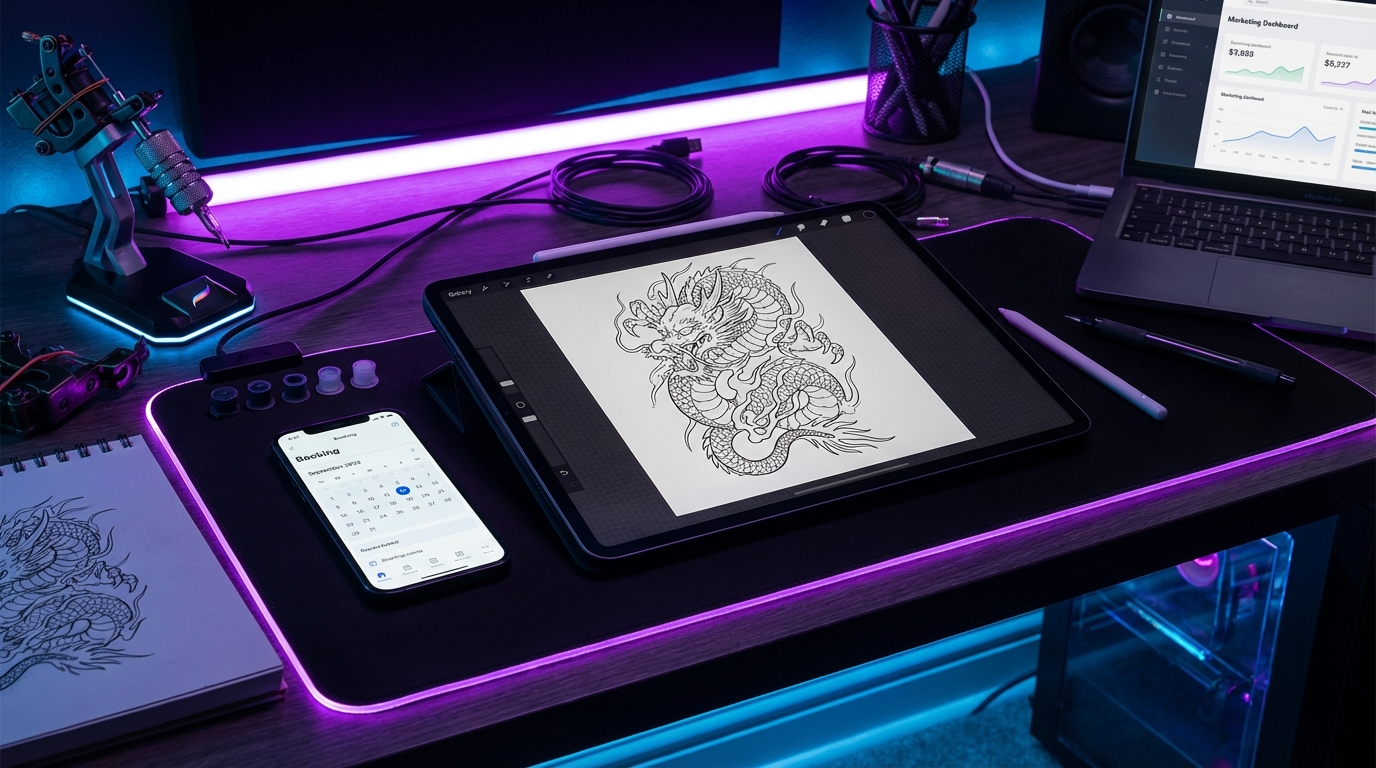
Opening a tattoo studio in 2026 involves more paperwork than most future owners expect — but nothing insurmountable if you follow the logical sequence. This guide condenses the steps for an independent studio in Europe, in the order they should be done, over 90 days. For the complete studio-management pillar, read our « Tattoo studio management » pillar guide first; this article focuses on opening alone.
Day 1-15: legal setup and structure
First question to settle is your legal status. Three realistic options in most EU jurisdictions: entry-tier self-employed (UK: sole trader / self-employed, FR: micro-entrepreneur, DE: Freiberufler), full sole trader at real cost, or company (UK: Ltd, FR: EURL/SASU, DE: GmbH). For 80% of solo studio openings, entry-tier self-employed is the right starting point (simple admin, flat-rate social charges). The trade-off detail lives in the legal-setup section of the pillar — it's the most important decision for the next 12 months.
Registration through your country's business portal (UK: HMRC, FR: INPI guichet, DE: Finanzamt). Count 7-15 days to receive your business identifier. You can't sign a commercial lease before that.
Day 15-30: venue and lease
Three criteria filter venues: public-establishment compliance (fire safety, occupancy limits), disability access (mandatory across most EU since 2015), commercial zoning (your landlord must be able to issue a commercial lease for tattooing — some leases exclude artisanal-health activities).
Standard commercial leases run 3-6-9 years in most EU countries. Always negotiate a rent-free period (3-6 months for preparatory works). Verify the use clause explicitly authorises tattooing.
Build-out works: mechanical ventilation, dedicated water point near the tattoo station, washable surfaces (floors/walls up to 1.80 m), separate sterile-material storage. Count £/€7k-22k depending on initial state.
Day 30-45: hygiene training and health-authority registration
The mandatory hygiene and safety training (21 hours in France, equivalent BBP training in UK/Germany/Netherlands) must be completed at an accredited body before any activity. Verify the list on your local health authority's website. Count £/€350-650 for the course, dates spaced out (book in advance). If you already hold the training from a previous employment, validate it's still current (no strict legal duration but renew at every major practice change).
Once trained, register your activity with your local health authority (France: ARS, UK: local council EHO, Germany: Gesundheitsamt). Processing time 1-2 months — you can open before written confirmation if your file is complete, but the receipt acknowledgement is what matters in case of inspection.
Day 45-60: insurance and compliance
Three insurances to subscribe in parallel:
- Professional liability insurance — covers harm to a client (allergy, infection, professional fault). Market standard: £/€300-650/year for a solo artist.
- Premises insurance — covers fire, water damage, theft, vandalism. ~£/€250-500/year depending on surface and equipment value.
- Health insurance mandatory if you employ staff, optional but recommended for solo.
For what French law requires from a tattoo studio, see our tattoo artist insurance guide.
Day 60-75: equipment and supplies
Minimum start-up list
- 1 main machine (rotary or coil depending on style) + 1 backup
- Initial cartridges/needles stock (3 months) from brands with traceable lot/expiry
- REACH-compliant inks (verify the latest authorised pigment list, 2024 update)
- Disposable consumables: non-powdered nitrile gloves, barrier films, disinfectant wipes, hypoallergenic soap
- Ultrasonic bath if you reuse certain accessories — otherwise everything disposable
- Ergonomic workstation: adjustable chair, daylight LED lamp, tablet/PC station
- iPad Pro + Procreate for design (see our iPad tattoo app comparison)
- Studio management software with online deposits (see our comparison of 5 tested apps)
- SumUp / Stripe terminal for in-person and online deposit payments
- Comfortable client chair or table (count £/€700-1800 for a pro reclining model)
Total equipment budget for a solo station: £/€3 500 to £/€7 500. You can stagger via leasing or an 18-36 month business loan to avoid tying up your cash.
Day 75-90: identity, marketing, first appointments
While admin wraps up, launch your dedicated Instagram account. Don't reuse your personal account: Instagram's free pro option unlocks discovery analytics. Minimum target before opening: 30-50 posts (a mix of available flash, your background, inspiration references). See our marketing pillar guide for the complete strategy.
Create a Google Business Profile as soon as you have a validated postal address (keys to the venue). This is what surfaces your studio in Google Maps and lets clients leave reviews. The first 10 reviews are the hardest to get — actively ask your first clients.
Configure your management software with a written deposit policy. 2026 standard: £/€30-50 for a small piece, £/€80-150 for a large piece, non-refundable on cancellations under 48 h. Charge via Stripe or SumUp linked to your software — not manual bank transfer (high abandonment rate).
Common opening mistakes
- Signing the lease before the business ID — legally risky, some landlords void the contract.
- Underestimating works duration — a non-compliant venue can take 3-4 months to bring to code, not 3 weeks.
- Postponing hygiene training — without it, no valid health registration, and an inspection can shut you down.
- Starting without management software — the spreadsheet + manual SMS spiral cost many studios real revenue in year one.
- Manual bank transfer deposits — maximum client friction, 30-50% abandonment at confirmation.
- Launching Instagram on opening day — algo takes 2-3 months minimum to start pushing your posts. Start 60 days before.
Total cost breakdown
Realistic budget to open a solo studio in a mid-market European city in 2026 (excluding property purchase):
- Legal setup + formalities: £/€0-200
- Hygiene training: £/€350-650
- Deposit and first 3 months rent equivalent: £/€2 500-5 000
- Build-out works: £/€7 000-22 000 (highly variable)
- Initial equipment: £/€3 500-7 500
- Year 1 insurances: £/€600-1 200
- Communications / Google Business / 3-month software subscriptions: £/€300-600
Total ranging from £/€14 000 to £/€36 000 depending on city, venue state, equipment level. Count 6 months of working capital on top for fixed charges before revenue covers outflows.
What's next
Once the studio is open, the work shifts to management: pricing, taxes, marketing, retention. All of it is in the « Tattoo studio management » pillar. If you haven't yet settled your entry path (training, first studio apprenticeship), the « How to become a tattoo artist » pillar guide covers everything from scratch.