A tattoo artist works on a client's skin, with needles and inks. French law regulates the hygiene of that act closely, and regulates its insurance far less than is commonly written. This article separates the two: what the law actually requires from a tattoo studio, what a professional liability policy and a multi-risk policy cover, and the Insurance Code mechanisms that apply to every contract, whatever the insurer. It compares no offers and names none. For the wider management framework, start with the « Tattoo studio management » pillar; for the opening sequence, the 90-day checklist.

What the law requires from a tattoo artist, and what it does not
In France, an insurance is mandatory only when a legal text makes it so. For professional liability, such texts exist for certain regulated professions: healthcare, legal professions, building trades with the ten-year guarantee, real estate agents, among others. The service-public sheet « Assurances de l'entrepreneur individuel », verified on 7 July 2026, states the rule: certain regulated activities or regulated professions may be subject to an insurance obligation covering the risks of practising the profession.
Tattooing is a regulated activity, but the regulation is about hygiene. Articles R1311-1 to R1311-13 of the Public Health Code impose the declaration to the regional health agency (R1311-2), the hygiene and sanitation training (R1311-3), client information before and after the act (R1311-12), and rules on equipment and waste. None of these articles mentions insurance. The service-public sheet « Tatouage : quelles sont les règles ? », verified on 13 November 2025, does not mention it either. Professional liability insurance for a tattoo artist is therefore optional under French law.
It is described as mandatory almost everywhere for two reasons that have nothing to do with a legal text: healthcare professions, whose hygiene vocabulary tattooing borrows, are subject to it, and most contracts a tattoo artist signs require it. What is actually mandatory for a studio comes from the rules common to every business, listed in the same service-public sheet:
| Insurance | Status for a tattoo studio | Source |
|---|---|---|
| Professional liability | Optional under the law. Often required by contract (lease, studio collaboration). | Public Health Code, articles R1311-1 to R1311-13, no mention of insurance |
| Premises insurance | Mandatory if you rent your premises. | service-public, sheet F37364, verified 7 July 2026 |
| Vehicle insurance | Mandatory for any vehicle used for the activity. | service-public, sheet F37364 |
| Employees' complementary health cover | Mandatory from the first employee. | service-public, sheet F37364 |
| Multi-risk, business interruption, owner's income protection and health top-up | Optional. | service-public, sheet F37364, optional insurances section |
Then there is the contractual obligation. A commercial lease usually requires a certificate of premises insurance, and a studio hosting a collaborating artist frequently asks for a liability certificate before the first session. That requirement comes from the contract you sign, it carries the force of that contract, and it ends with it. It is not the law speaking, it is the other party.
Why your liability is engaged, insured or not
The absence of an insurance obligation changes nothing about liability itself. Article 1240 of the Civil Code sets the general rule: any act that causes damage to another obliges the person through whose fault it occurred to repair it. Between a tattoo artist and a client there is also a contract, and article 1231-1 provides for damages when that contract is not performed, or performed badly.
For a studio, the situations are well known: an infection after a session where hygiene is questioned, a reaction to a pigment whose compliance is not established, a client who did not receive the information on risks and aftercare that article R1311-12 makes mandatory. The criminal penalties of article R1312-9 of the Public Health Code, a fifth-class offence, are a separate matter: a fine punishes, it does not compensate the client.
Insurance therefore does not change your liability. It changes who pays the compensation when it is due: the insurer within the limits of the contract, or you beyond those limits and in the absence of a contract.
Tattoo artist liability insurance: what a professional liability policy covers
A professional liability policy pays for bodily, material and immaterial damage caused to third parties by the insured activity, within the limits, ceilings and exclusions written in the policy. For a tattoo artist, the third parties are first of all clients, and the typical damages are those of the previous section: skin reaction, infection, burn linked to equipment, a line to redo or to have removed.
Two neighbouring covers carry similar names. Public liability (responsabilité civile exploitation) covers the life of the premises: a client who falls in the studio, damage caused to a neighbour. Professional liability (responsabilité civile professionnelle) covers the act itself. Depending on the contract, both appear in one policy or in two separate ones; the wording of the covers and exclusions is what counts, not the commercial title.
Side activities, piercing, permanent makeup, classes, guest spots in another studio, are risks distinct from tattooing. Article L113-2 of the Insurance Code obliges the insured to declare at subscription every circumstance known to them that lets the insurer assess the risk, then to declare during the contract those that aggravate it. An activity added after signing falls in that second category.
The insurance certificate, the one a studio or landlord asks you for, restates these elements: the insured's identity, the declared activities, the period of validity and the covers taken out. A studio hosting you as a guest reads the activities line first.
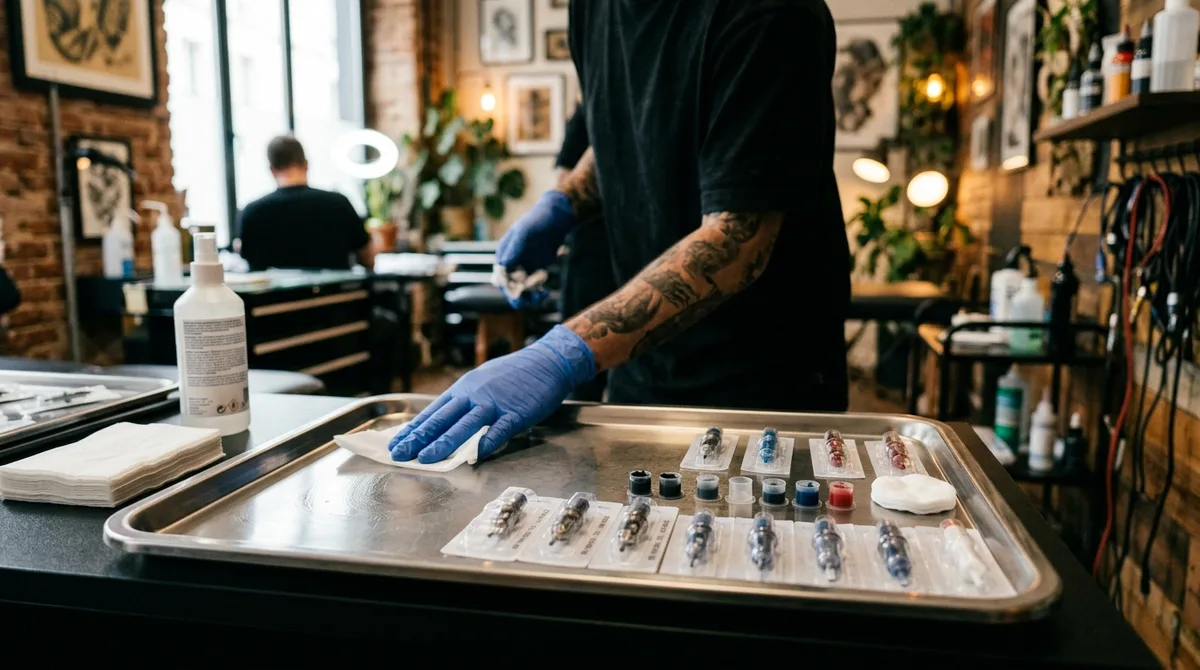
Multi-risk professional insurance: premises, equipment, business interruption
Service-public describes multi-risk professional insurance as an adaptable contract that lets you choose the extent of the covers. It usually groups damage to the premises and their contents, fire, water damage, theft, equipment breakage, and often public liability. It sits in the optional insurances section of sheet F37364.
Optional does not mean unrelated to an obligation. If you rent, you must insure the premises, and the multi-risk policy is the contract that most often fulfils that obligation, because it includes tenant's risks. The lease usually specifies the covers the owner expects and the yearly delivery of a certificate.
Business interruption is an optional cover, often offered as an add-on to the multi-risk policy. It compensates the margin the studio does not generate during a closure following a covered loss. Whether it is included, for how long, and how it is calculated are set by the contract.
Reading a contract: the mechanisms set by the Insurance Code
Whatever the company, four rules of the French Insurance Code apply to your contract. Knowing them means knowing what to read in the special conditions.
Risk declaration and the proportional rule
Article L113-9 deals with an omission or inaccurate declaration made without bad faith. It does not void the contract. Discovered before any loss, it lets the insurer keep the contract against a premium increase or terminate it. Discovered after a loss, it reduces the indemnity in proportion to the premiums paid compared with the premiums that would have been due had the risks been fully and accurately declared. For a tattoo artist, turnover, floor area or a side activity declared below reality produce exactly that effect.
Exclusions
Article L113-1 places losses and damage caused by the insured's fault on the insurer, except for a formal and limited exclusion contained in the policy. An exclusion must therefore be written and delimited to apply. Intentional or fraudulent fault is never covered.
Occurrence or claims-made basis, and run-off cover
Article L124-5 provides that a liability cover is triggered either by the harmful event or by the claim. On a claims-made basis, the contract covers claims received during its term and during a so-called subsequent period after termination, whose length is set by the policy. An infection or reaction that surfaces months after the session, once you have changed insurer, falls under these provisions: the basis used and the length of the run-off cover are written in the special conditions.
Ceiling and excess
The ceiling is the maximum amount paid, per loss and per insurance year. The excess is the part of each loss that remains yours. Both are figures of the contract, specific to each offer, and together they determine what the insurer actually pays.
Who advises on an insurance contract
Insurance distribution and advice are regulated activities in France. Intermediaries, brokers and general agents, are listed in the register kept by ORIAS, searchable online, and insurers also distribute their contracts directly. They are the ones who analyse a declared activity, premises and turnover, and turn that into covers. This article stops at the legal framework.
About this article
Marc Vernes is neither an insurer nor an intermediary registered with ORIAS. This text describes the French legal framework in force at its update date, based on the texts cited: Public Health Code (articles R1311-1 to R1311-13 and R1312-9), Civil Code (articles 1240 and 1231-1), Insurance Code (articles L113-1, L113-2, L113-9 and L124-5), service-public sheets F37364 (verified 7 July 2026) and F22481 (verified 13 November 2025). It compares no offers and does not replace the analysis of your situation by a registered intermediary or an insurer.
Last updated: September 2026.
Once the framework is in place
A contract protects the studio when something goes wrong. What fills the calendar is decided earlier: in what a client sees of your work at the moment of choosing. A piece that moves gets noticed where a photo gets forgotten.
On our side, animating one piece costs 10 credits. The €7.99 pack contains 45, which is four animations.
Create my accountThe 3 credits given at sign-up cover design generation, not animation.