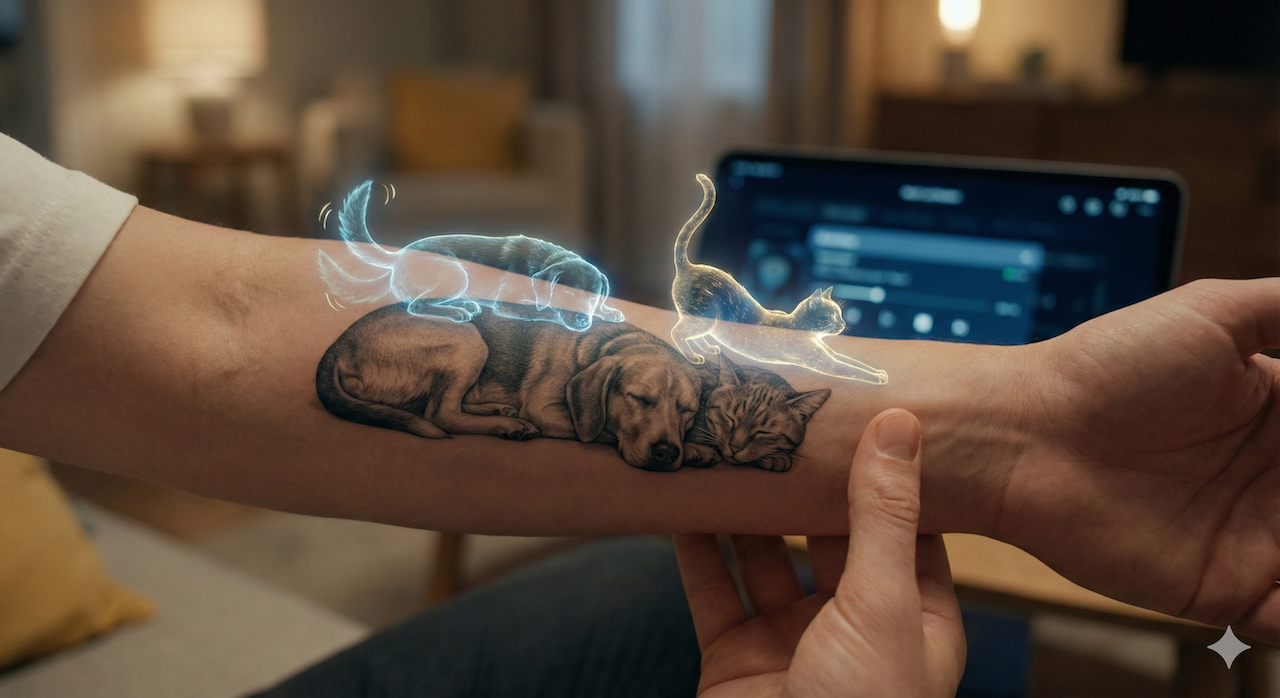
The loss of a pet is an ordeal often underestimated by society, but devastating for those who experience it. It is a "disenfranchised grief," a silent pain. For decades, tattooing has served as an outlet, a way to engrave in the flesh the memory of the one who shared our daily life. But in 2025, ink is no longer enough. A silent revolution is underway in tattoo studios: the convergence of body art and artificial intelligence to offer a form of "digital resurrection."
This article explores how AI animation transforms the memorial tattoo, moving from a static image to a living memory, capable of capturing the breath, the gaze, and the very essence of our departed companions.
Beyond Ink: The Psychology of Animated Memorial Tattoos
To understand the impact of this technology, one must first understand the need it fills. The grief tattoo is not a simple decoration; it is a rite of passage. It allows the absence to be materialized.
When we add the dimension of animation, we touch on something much deeper cognitively. Our brain is programmed to react to movement. Seeing a still image of your dog is moving, but seeing that same dog "blink" or "turn its head" via your phone screen activates areas of the brain linked to real presence.
Studies in cyberpsychology suggest that these digital avatars can help in the grieving process, provided they are used as bridges to memory and not as a denial of reality. AI allows freezing not only the appearance but also the "kinetics" of the animal: its unique way of moving. That is where the true magic of tattoo animation lies in 2025.
Editor's Note: If the subject of pet loss touches you, we recommend reading resources on pet grief, which offer valuable support.
The Technical Challenge: Why Animating Fur is a Feat for AI
We have often discussed on Encre Vive the difficulty of animating human skin. But animating the representation of an animal on this same skin adds an exponential layer of complexity. For a generative AI or an automated motion design tool to successfully animate a cat or dog tattoo, it must overcome three major obstacles that you must know before going under the needle.
Procedural Fur Texture
Unlike a human face which is a relatively smooth surface with clear landmarks (eyes, nose, mouth), an animal is composed of thousands of strands of textures. The AI must understand that movement does not happen in a block. If your dog turns its head in the animation, the neck fur must compress, while the back fur stretches.
Algorithms in 2025 now use "Fur Flow Mapping." They analyze the direction of the tattoo artist's needle strokes to deduce the direction of the hair and apply realistic physical movement to it. This is why the technical quality of the initial tattoo is paramount: a tattoo with "messy" shading will result in a blurry and incoherent animation.
Eye Contrast, Window to the Digital Soul
For an animation to be emotionally credible, everything plays out in the gaze. Current animation software (such as those based on Live Portrait technologies) primarily looks for specular reflections in the eyes – those small white dots that indicate light and life.
If your animal tattoo has eyes that are too dark or dull, the AI will not be able to "hook" the gaze to animate it. The result will be a robotic head movement, without that spark of life. It is therefore crucial to ask your tattoo artist to accentuate the contrasts and reflections in the animal's eyes, even more than on the reference photo.
The Best Performing Artistic Styles for Animal Animation
Not all tattoos are born equal before artificial intelligence. If your goal is to have an "animatable" tattoo for your social networks or for your private use, the choice of artistic style is decisive. We have analyzed the trends and here is what works best.
Micro-Realism: The Royal Road
Micro-realism is undoubtedly the style that offers the most breathtaking results. This style, which is akin to high definition on skin, provides the AI with all the necessary information to build a convincing 3D animation. The fine details of the whiskers, the wet texture of the nose, and the depth of field allow algorithms to separate the foreground from the background.
However, beware of aging. Micro-realism tends to fade (the famous "ink drift") faster than thick lines. An animation made on a fresh tattoo will be magnificent, but in 5 years, if the lines thicken, the AI will have a harder time interpreting the image.
Sketch Style
This is a fascinating artistic alternative. Instead of trying to imitate photographic reality, the "Sketch" style (visible construction lines, penciled look) allows for very poetic animations. The AI can be parameterized to make the lines vibrate, giving the impression that the drawing is being made by an invisible hand in real-time.
This style is perfectly suitable for owners who want a less literal, more artistic tribute. The animation here does not seek to say "look, he is alive," but rather "look, this memory is a work of art in motion."
Tutorial: How to Capture the Perfect Photo for AI
You have the tattoo, you have the app, but the result is disappointing? In 90% of cases, the problem comes neither from the tattoo artist nor from the AI, but from the source photo. Artificial intelligence needs clean data to work. Here is how to optimize your shot for a perfect animation.
Managing Polarized Light
The worst enemy of tattoo animation is reflection. Skin is an oily and irregular surface that reflects light. These white reflections "break" the lines of the drawing for the AI. For a professional quality photo, the ideal is to use soft and indirect light. If you can, use a polarization sheet on your phone lens (there are inexpensive accessories for this). This eliminates skin reflections and only lets the ink pigment be seen under the epidermis. The AI will then be able to read the tattoo as a flat and perfect image.
The Importance of Flat Perspective
AI hates distortion. If you take your forearm tattoo at a weird angle, the algorithm will try to animate a deformed dog. It is imperative to take the photo perfectly parallel to the tattooed area. If the tattoo wraps around the arm, take several photos and use stitching software (panorama) or concentrate the animation only on the most visible face, generally the animal's face.
For more on tattoo photography techniques, consult this external guide on Tattoo Photography Techniques.
The Future: Augmented Reality and Sound Tattoos
We are only at the beginning of this technology. By 2026, we predict a complete fusion between visual and sound animation. Pioneering companies like Skin Motion have already paved the way with soundwave tattoos.
Imagine pointing your phone at your cat's tattoo: not only do you see it meow thanks to AI animation, but you actually hear its recorded meow, spatialized in 3D thanks to augmented reality. This "Audio + Video + Body Anchoring" coupling represents the ultimate stage of the memorial tattoo. It is no longer about seeing, but feeling a multisensory presence.
Conclusion: A New Way to Remember
The integration of AI into the art of tattooing raises ethical and philosophical questions, but above all, it offers unprecedented comfort. It does not replace the memory, it augments it. It allows transforming a frozen image into a sequence of pure emotion.
Whether you choose realism or abstract, the important thing is that the tattoo resonates with your story. AI is just a tool at the service of your memory, a technological means to say, once again: "I do not forget you."