Do you remember 2018?
It was a simpler time. You could finish a tattoo, wipe it down with green soap, snap a quick photo with your iPhone 8 (under a flickering shop light), slap a "Clarendon" filter on it, and post it to Instagram. The result? 2,000 likes, 50 comments, and a DM inbox full of booking requests.
Fast forward to 2026. The game has changed completely.
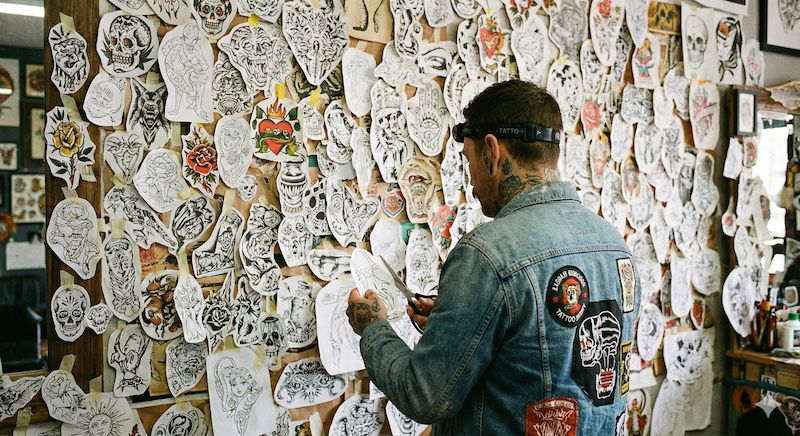
Today, walk into any reputable tattoo convention or high-end street shop, and it looks less like an art studio and more like a Hollywood film set. Every apprentice has a Sony A7III, a $200 CPL (Circular Polarizer) lens to cut the glare, and a dual-ring light setup. The bar for "good photography" has skyrocketed. We have reached "Peak Photography."
The problem? When everyone has a perfect photo, no one stands out.
You are posting world-class art. Your linework is crisp, your saturation is solid. Yet, your engagement is dropping. Your reach is flatlining. Why? Because you are fighting a 2026 war with 2018 weapons.
The era of the static image is ending. We are entering the era of the "Living Portfolio."
In this guide, we are going to break down why the algorithm hates your photos, why motion is the only way to showcase the true quality of your work, and how you can switch to a motion-first strategy without becoming a video editor.
The Algorithm Has Picked a Side (And It’s Not Photos)
You might think that Instagram, TikTok, and Pinterest are neutral platforms that just show people "what they like." This is false. These platforms are businesses, and their currency is Attention.
The Shift to "Retention Time"
The algorithm doesn't care about "Art." It cares about Retention Time—how many seconds a user spends staring at your post before scrolling.
Here is the brutal math of the "Scroll Test":
- A Photo: The human brain processes a static image in about 13 milliseconds. A user scrolls, glances at your tattoo photo for 0.5 seconds, double-taps (maybe), and moves on. Total retention: <1 second.
- A Motion Loop: A video or animated image automatically triggers a "stop" response in the brain. The user watches the movement to understand what is happening. Even a short loop holds attention for 3 to 6 seconds.
That is a 600% increase in retention time. To the algorithm, that signals that your content is "high quality" and "engaging," so it pushes it to the Explore Page.
According to data from Hootsuite, video content generates significantly more engagement than any other content type across all major social platforms. If you are strictly posting photos in 2026, you are voluntarily hiding your work from 80% of your potential audience.
The "Video-First" Declaration
This isn't a secret. Adam Mosseri, the Head of Instagram, declared years ago that Instagram is "no longer a photo-sharing app." They are an entertainment app competing with TikTok. They prioritize Reels and video content by design.
If you are a tattoo artist trying to grow a business, ignoring this shift is like refusing to use a rotary machine because you "prefer the noise of coils." You can do it, but you are making your life harder than it needs to be.
What is a "Living Portfolio"?
So, if the photo is dead, what replaces it?
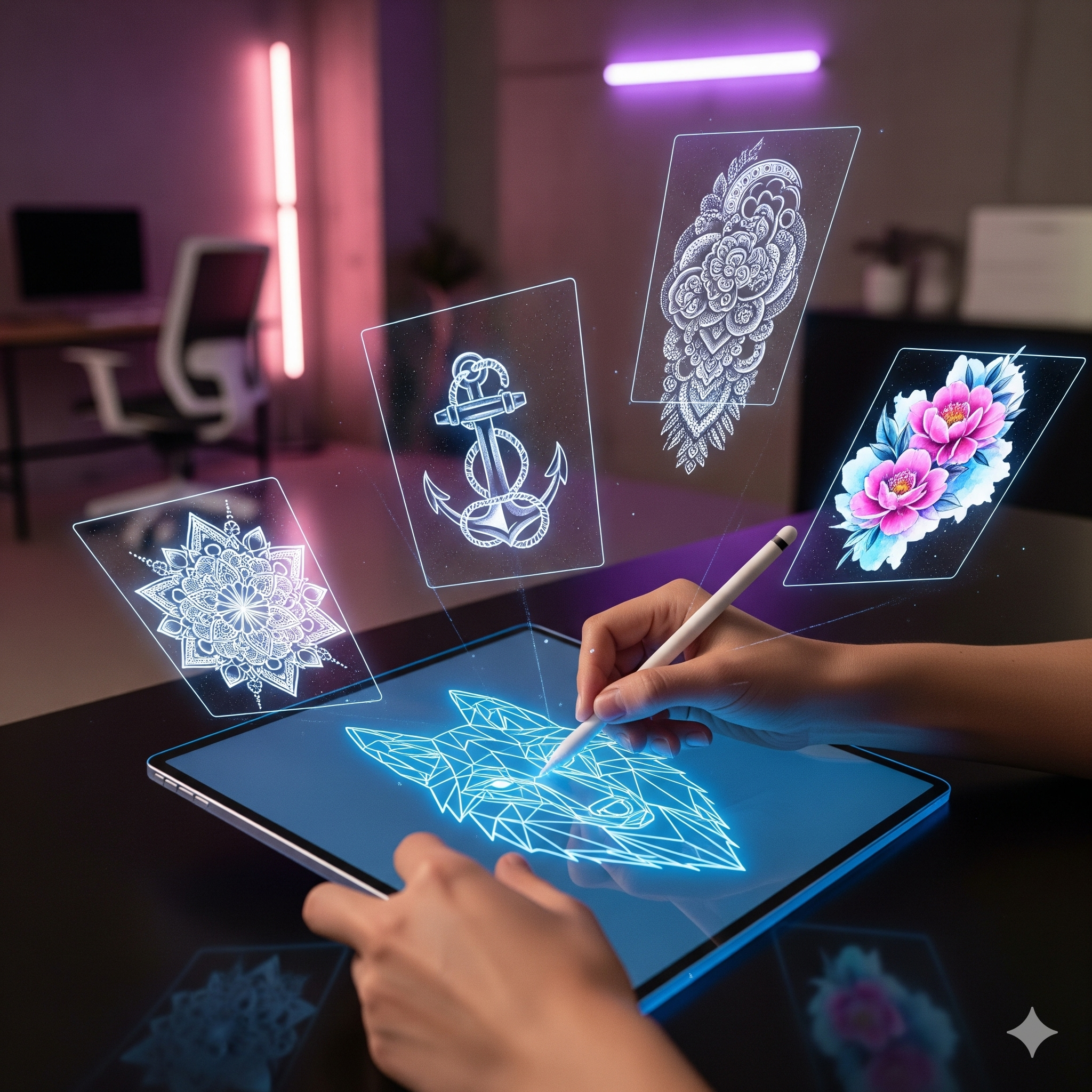
We are seeing the rise of the "Living Portfolio." This is a feed where the ink doesn't freeze. Instead of a gallery of dead stills, your portfolio becomes a collection of breathing, moving art.
This doesn't mean you need to film yourself dancing or pointing at text bubbles. It means the tattoo itself should be the source of motion.
A Living Portfolio uses AI animation tools to add subtle movement to the design. A dragon breathes smoke. A floral piece has petals that gently drift in the wind. A geometric pattern pulses with neon light.
Why do luxury brands use video ads instead of flyers? Because motion signals high production value. When a potential client lands on your profile and sees every tattoo gently moving, it creates a "Harry Potter" effect. It feels magical. It feels expensive. It immediately separates you from the 50 other artists in your city who are just posting static JPEGs.
Why Motion Wins: The Artistic Argument
Forget the algorithm for a second. Let’s talk about the Art. As tattooers, we constantly complain that "photos don't do it justice." And we are right. A photo is a 2D capture of a 3D object.
1. Showcasing "Flow" and Anatomy
The hardest skill to master in tattooing isn't lining or packing color; it’s placement. It’s making the design flow with the anatomy of the body.
- The Photo Problem: When you take a photo of a wrapped sleeve or a rib piece, the camera lens flattens the image. The curve disappears. The "Flow" you worked so hard to achieve looks distorted.
- The Motion Solution: By animating the design—for example, making a snake slither along the curve of the muscle—you re-introduce the concept of volume. You show the client: "Look how this design lives on the body."
2. The "Glare" Camouflage (The Secret Weapon)
This is the benefit pros love the most. Taking a photo of a fresh tattoo is a nightmare. The skin is red and angry. The pores are open. There is plasma weeping. And the glare from your softbox hits the shiny ointment, obscuring the black ink.
To fix this, photographers buy expensive polarizing filters. But there is another way.
Motion acts as camouflage. When you add a subtle animation effect—like a soft "mist" rising from the tattoo or a "glow" effect on the highlights—it draws the viewer's eye away from the skin texture and toward the design.
The redness becomes less noticeable. The glare becomes part of the animation. The focus returns to your art, not the trauma of the skin.
The 3 Levels of Motion (Choosing Your Vibe)
One of the biggest fears artists have is: "I don't want my portfolio to look like a cheap cartoon." Valid concern. The key is to match the animation style to your tattooing style. You wouldn't put a Bold Will Hold outline on a Micro-Realism piece. The same applies to motion.
Here are the three tiers of the Living Portfolio:
Level 1: The "Subtle Motion" (Best for Fine Line / Micro-Realism)
This is the luxury approach. The goal here is that the viewer might not even notice the movement at first glance.
- The Effect: A single butterfly wing flapping once every 5 seconds. A teardrop slowly falling. A soft shimmer on a jewelry tattoo.
- The Vibe: Elegant, expensive, "Quiet Luxury."
Level 2: The "Impact Loop" (Best for Traditional / Neo-Trad / Newschool)
This style is bold and punchy. It mimics the high-contrast nature of the tattoo style.
- The Effect: Lightning bolts striking around a panther. A dagger shaking upon impact. Eyes blinking rapidly. Flames roaring.
- The Vibe: Energetic, fun, "In Your Face."
Level 3: The "Atmospheric" (Best for Blackwork / Dark Art / Horror)
Here, you are selling a mood.
- The Effect: Heavy rain falling over a gothic cathedral. Thick fog rolling off a skull. Glitch effects or "TV Static" for Cyber-Sigilism.
- The Vibe: Moody, dark, immersive.
"But I'm Not a Video Editor" (The Solution)
This is the main reason artists haven't switched yet. You are a tattooer, not a motion designer. The "Old Way" of doing this involved:
- Taking a photo.
- Importing it into Adobe After Effects.
- Masking out the layers manually.
- Setting keyframes.
- Rendering.
That takes 2 hours per tattoo. You don't have time for that.
The New Way: AI-Powered Animation
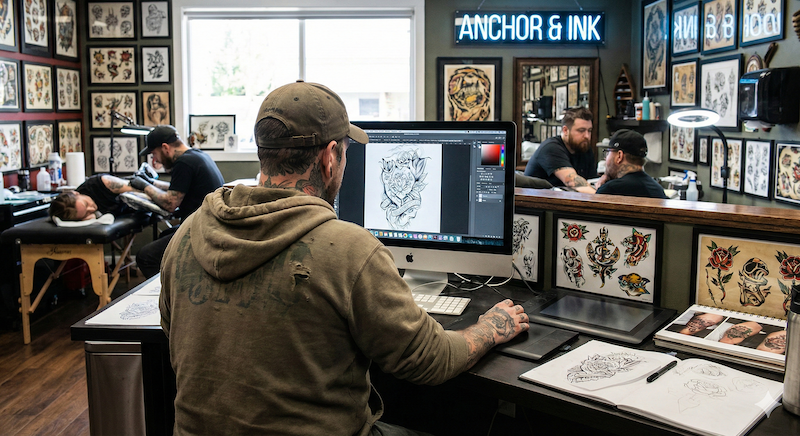
This is where tools like Encre Vive change the workflow. By using AI to detect the lines and subject of the tattoo, the "tech" part is automated.
- Snap & Edit: Take your photo as usual (edit the contrast/blacks in Lightroom on your phone).
- Upload: Send the photo to the AI tool.
- Select Area: Brush over the part you want to move (e.g., the smoke, the water, the hair).
- Choose Preset: Select "Ink Flow" or "Breathe."
- Export 4K: Download as a vertical video (9:16) for Reels.
You get the viral benefits of video without needing a degree in animation.
Case Study: The Engagement Gap
Let’s look at a hypothetical (but realistic) A/B test based on data we see from users.
The Artist: Sarah, a floral Blackwork artist. The Subject: A Peony tattoo on the thigh.
Post A (The Static Photo)
Format: Carousel of 3 photos.
Quality: Crisp, polarized, edited.
Results:
- Reach: 450 accounts (mostly her existing followers).
- Likes: 120.
- Saves: 5.
Why? The algorithm saw it was a photo and limited the reach.
Post B (The Living Portfolio)
Format: Instagram Reel.
Content: The same photo, but the petals are gently "breathing" and there are floating dust particles.
Results:
- Reach: 3,200 accounts (50% non-followers via Explore).
- Likes: 600.
- Saves: 85.
- Inquiries: 2 DMs asking for "something similar."
The Takeaway: The quality of the tattoo was identical. The packaging determined the success. Post A was invisible. Post B was a magnet.
Conclusion: Don't Be a Dinosaur
The tattoo industry evolves fast. In the 90s, if you didn't have a physical portfolio binder in the waiting room, you didn't work. In the 2010s, if you didn't have an Instagram account, you didn't work. In 2026, if you don't have a Motion Strategy, you are working twice as hard for half the visibility.
The "Living Portfolio" isn't a gimmick. It is the natural evolution of showcasing visual art on digital screens. It solves the glare problem, it solves the anatomy problem, and most importantly, it solves the algorithmic problem.
You have already done the hard part—you did the tattoo. Don't let that masterpiece die in the feed because you presented it as a static JPEG.
Ready to wake up your portfolio? Stop posting dead photos. Transform your best piece into a Living Asset in under 60 seconds.
Get 3 Free Credits to Animate Your First Tattoo Here