Hygiene in a tattoo studio is not a matter of good intentions: it is a set of precise texts that say what the premises must be like, how hands are washed, what must be sterile and single-use, what inks may contain, where waste goes, and what the client must know before sitting down. This article takes them one by one, with a link to each. The mandatory training and its certification have their own article, « Tattoo hygiene and sanitation training in France »; the management framework is in the « Tattoo studio management » pillar.
The base: articles R1311-1 to R1311-13 of the Public Health Code
Everything starts from articles R1311-1 to R1311-13, from decree no. 2008-149 of 19 February 2008. They apply to skin-piercing tattooing, permanent makeup included, and to body piercing, except ear and nose piercing with a gun. They require:
| Article | Obligation |
|---|---|
| R1311-2 | Declare the activity to the director general of the ARS of the place of practice. |
| R1311-3 | Have completed the hygiene and sanitation training, today ending in an ARS certification. |
| R1311-4 | Comply with the general hygiene and sanitation rules, set by order. |
| R1311-5 | Dispose of waste under the rules for infectious healthcare waste. |
| R1311-10 | Use only products, inks included, compliant with the regulation. |
| R1311-11 | Obtain the written consent of a parent or guardian for a minor, and keep proof for three years. |
| R1311-12 | Inform the client, before the act, of the risks involved and, afterwards, of the precautions to follow. |
The good practices of the order of 11 March 2009
The general hygiene rules of article R1311-4 are written in the order of 11 March 2009, still in force, whose annex I describes the premises, the gestures and the equipment:
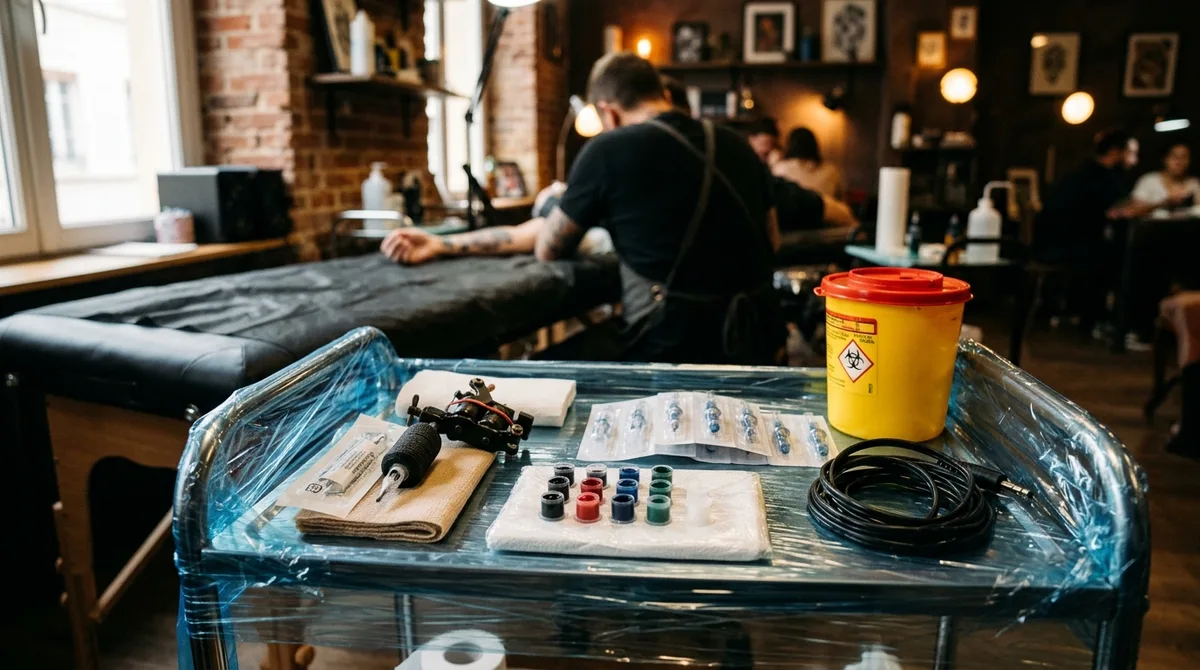
- The premises: a dedicated technical room, with smooth, non-porous, washable floors and work surfaces, separate areas for cleaning and sterilising equipment and for storing waste.
- Cleaning: daily cleaning by wet bio-cleaning decontamination of the room, and disinfection of surfaces between each client.
- Hands: all jewellery removed before hand disinfection, single-use gloves changed between clients.
- Equipment: needles penetrating the skin barrier are sterile and single-use; reusable equipment follows the protocol of annex III, pre-disinfection, cleaning, sterilisation.
- The skin: a four-phase preparation, cleansing, rinsing, drying, antisepsis.
These rules are the ones the hygiene and sanitation training teaches and the ARS checks. They leave no room for interpretation: what penetrates the skin is sterile and discarded after use, what touches it is disinfected between two clients.
Inks: the REACH regulation, entry 75
The composition of inks is a matter of European law. Regulation (EU) 2020/2081 added to Annex XVII of the REACH regulation an entry 75 devoted to tattoo inks and permanent makeup. The restriction has applied since 4 January 2022, and since 4 January 2023 for pigments Blue 15:3 and Green 7, which had a delay for lack of alternatives.
Restricted, above thresholds set by the text, are substances classified as carcinogenic, mutagenic or toxic for reproduction, skin sensitisers, substances corrosive or irritant to skin or eyes, certain aromatic amines and colourants, and substances banned in cosmetics. The regulation also imposes labelling: the statement « Mixture for use in tattoos or permanent make-up », a batch number, the list of ingredients, and warnings for nickel and chromium VI, all clearly visible, easily legible and indelible.
For a studio, the obligation of article R1311-10 is checked bottle by bottle: regulatory statement present, legible batch, list of ingredients provided. A bottle without these elements cannot be used, whatever its origin.
Waste: assimilated to infectious healthcare waste
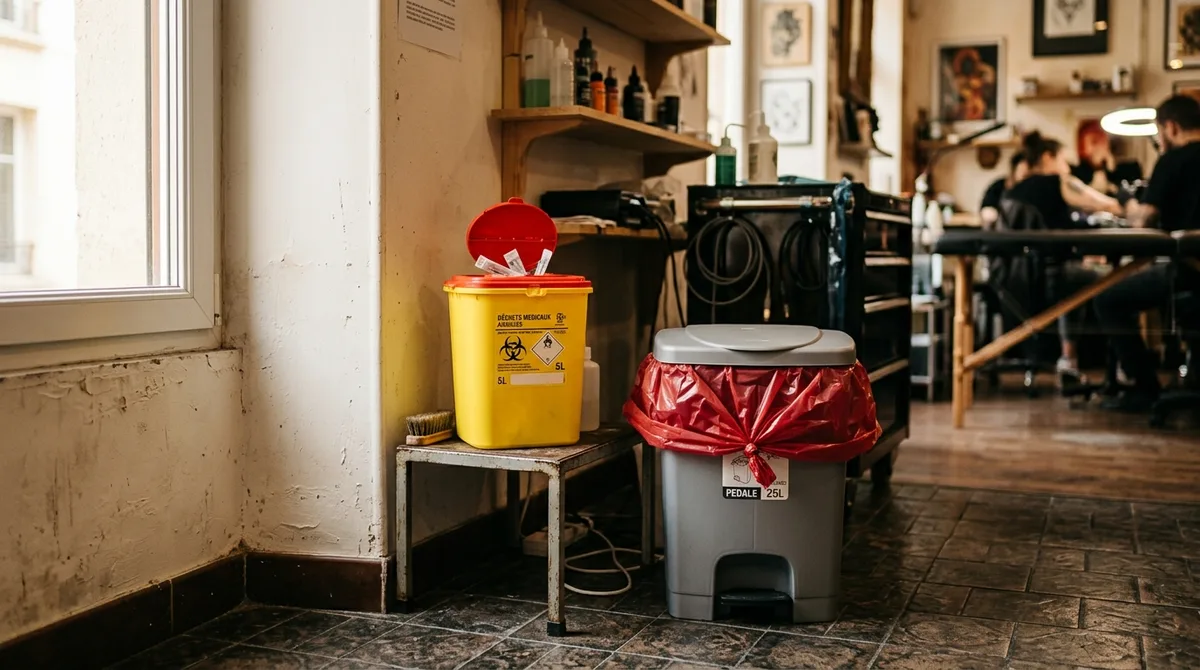
Article R1335-1 of the Public Health Code assimilates to infectious healthcare waste that arising from skin-piercing tattooing activities when it presents an infectious risk or is sharp. The following section sets the whole chain:
- R1335-2: any person producing waste defined in article R1335-1 is required to dispose of it; the responsibility is the studio's.
- R1335-3: disposal may be entrusted to a contractor by written agreement.
- R1335-4: tracking documents accompany each stage of disposal.
- R1335-5 and R1335-6: sorting at the point of production, single-use packaging closed before collection.
- R1335-7: storage durations and conditions set by the order of 7 September 1999, decreasing with the quantity produced: one month for production between five and fifteen kilograms a month, six months when the producer only produces sharps in that range.
- R1335-8: disposal by incineration or pre-treatment by disinfection.
In practice: standardised sharps containers, a contract with an approved contractor, tracking slips kept, and a separate storage area, as annex I of the 2009 order requires.
Client information and minors
Article R1311-12 requires informing the client before and after the act. The order of 3 December 2008, in force, sets its content: the irreversible nature of the tattoo, possible pain, infection risks, allergic risks linked to inks and jewellery, the search for contraindications, healing time and precautions to follow afterwards. This information is given orally, displayed visibly in the premises, and handed to the client. The service-public sheet « Tatouage : quelles sont les règles ? », verified on 13 November 2025, restates it for the public.
For a minor, article R1311-11 requires the written consent of a person holding parental authority or of the guardian, and the keeping of proof for three years. The information and consent form template is in « Client contract and consent ».
Proving compliance: what a studio keeps
The texts impose obligations, not a single register. In practice, proving compliance means keeping: the hygiene and sanitation certification and the acknowledgement of the ARS declaration, ink labels or sheets with their batch numbers, waste tracking documents and the contractor agreement, parental consents for three years, and the information sheet handed to clients. Management software can hold part of these records, a binder too: what matters is being able to present them.
Inspections and penalties
The regional health agencies check compliance with these rules. Breaches are punished by article R1312-9 of the Public Health Code: practising without a declaration, without training, without complying with hygiene rules, with non-compliant products, without informing the client or tattooing a minor without consent is punished with the fine set for fifth-class offences, that is €1,500 at most, which may be raised to €3,000 in case of repeat offence under article 131-13 of the Penal Code. Civil liability towards an injured client comes on top, the subject of the insurance guide.
Client data: the GDPR applies
A studio's client file holds identities, contact details, sometimes health indications, allergies or treatments, and photos. It is a processing of personal data within the meaning of the General Data Protection Regulation, with the obligations the CNIL details for client relations: inform people, limit collection to what is necessary, set a retention period, secure access. Publishing photos of pieces also falls under image rights, covered in « Tattoo studio communication ».
A studio's health compliance, in one list
- Valid hygiene and sanitation certification, ARS declaration made.
- Premises compliant with annex I of the order of 11 March 2009: dedicated room, smooth washable surfaces, separate cleaning and waste areas.
- Needles and skin-penetrating equipment sterile and single-use; sterilisation protocol for reusables.
- Inks labelled under REACH entry 75, batches kept.
- Waste sorted, standardised containers, contractor agreement and tracking slips.
- Client information displayed and handed over, written parental consent for minors, kept three years.
- Client file compliant with the GDPR, separate consent for publishing photos.
About this article
Marc Vernes is neither a lawyer nor an ARS officer. This text describes the French framework in force at its update date, from the texts cited: Public Health Code (articles R1311-1 to R1311-13, R1312-9, R1335-1 to R1335-8), order of 11 March 2009, order of 3 December 2008, order of 7 September 1999, Regulation (EU) 2020/2081, article 131-13 of the Penal Code, service-public sheet F22481 (verified 13 November 2025), CNIL. For your premises, your ARS remains the contact.
Last updated: September 2026.
A compliant studio, and a visible one
Compliance is proven to the ARS, it cannot be seen from the street. What the client sees is your work. A piece that moves gets noticed where a photo gets forgotten.
On our side, animating one piece costs 10 credits. The €7.99 pack contains 45, which is four animations.
Create my accountThe 3 credits given at sign-up cover design generation, not animation.