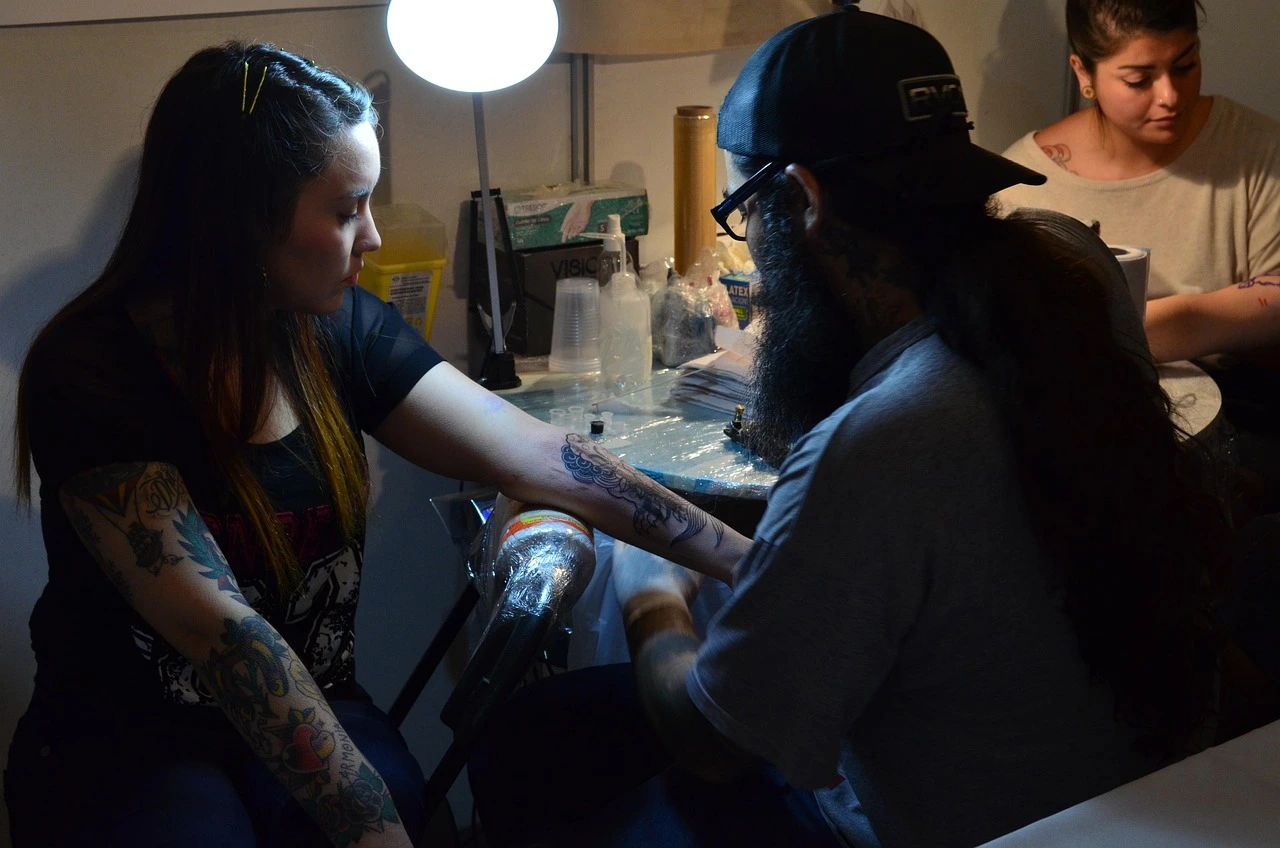
On 1 February 2026, the Grande Halle de la Villette closed the doors of the Mondial du Tatouage for the last time. The convention, created in 1999 by Tin-tin and grown over the years into a global reference, chose to stop — while the "tattoo trends" listicles republished, as they do every year, the same list: fine line, minimalism, botanical. This article does the opposite: separating what is really rising from what is recycled, explaining who manufactures the trends — social media, catwalks and even regulation — and giving you what you need to choose a design that will outlast a fashion.
A word on method first, because it governs everything else: you will find here no percentage of demand, no "+34% in searches". Nobody measures these figures — no organisation, in France or elsewhere, counts tattoo requests by style. What follows rests on cross-referenced qualitative observations: the public line-ups of the 2026 conventions, the portfolios of French tattoo artists, and the specialist and cultural press. Every observation is attributed to its source, and when a reading is analysis rather than fact, it is spelled out in black and white.
What's Really Rising in 2026: the Styles You See in Portfolios and at Conventions
Four families keep coming back this year in artists' portfolios, convention exhibitor lists and the specialist press. To place each one in the wider landscape, our tattoo styles guide serves as a map; here is what 2026 adds to it.
Micro-Realism and Fine Line: the Demand Is Massive, So Is the Debate
Miniature portraits, line-drawn animals, barely sketched flowers, flowing lettering: according to tattoo artists, fine line and micro-realism remain the most frequent requests in the studio, and the 2026 convention line-ups give them considerable space. The style speaks to those who want a discreet, precise tattoo, compatible with a strict professional setting or a cautious first project. Its promise: delicacy. Its point of caution, and it is a serious one: how very fine lines hold up over time is debated among tattoo artists themselves. We devote a whole section to it further down — you deserve to know before you decide, not after.
Ornamental Blackwork and Dark Botanical: the Dominance of Black
Ornamental compositions inspired by lace and mandalas, foliage and flowers rendered in deep black without a touch of colour, large graphic blocks of solid ink: black dominates French portfolios, and ornamental blackwork is its most requested form on a large piece. Why now? Tattoo artists point to its legibility and its staying power — professionals such as the Fabien Tattoos studio in Strasbourg publicly recall that black ages better than colour — and the regulatory context may have played its part, which we come back to below. The style speaks to those who embrace a visible, structured piece. A word of caution: large areas of solid black are a big commitment — long sessions, difficult cover-up later — so it is a project to let mature.
Cybersigilism and the Y2K-Techno Aesthetic: from the Catwalks to the Mainstream
Sharp lines, tapered points, curves that suggest both esoteric sigils and printed circuit boards, almost always in black, often placed on the sternum, the nape or the shoulders: cybersigilism is the most recognisable rising aesthetic of recent years. It speaks to a generation raised on internet culture and Y2K codes. How this style moved from techno clubs to fashion catwalks and then to studios is a textbook case we tell further down, in the section on how trends are manufactured. A double caution: its very fine lines raise the same staying-power question as fine line, and its heavy "era" anchoring makes it worth asking what it will evoke ten years from now.
Patchwork and the "Sticker" Style: Collecting Rather Than Composing
Independent pieces, medium in size, accumulated over the years with no overall composition — like stickers on a suitcase: patchwork is not a graphic style but a way of wearing tattoos, and it is probably the real generational break of the moment. Where the previous generation planned a coherent sleeve, some of the newly tattooed collect moments: one piece per trip, per period, per artist. A word of caution: total improvisation is paid for later — clashing sizes, gaps impossible to fill. Tattoo artists recommend raising it from the very first piece, to keep spacings and scales compatible with what comes next.
What Comes Back: Tattooing Works in Cycles, Not Novelties
Fashion has its well-known rule of thumb: what was once worn comes back roughly a generation later, mocked in the meantime. Tattooing no longer escapes it. The Y2K revival is the clearest example: lower-back tribal and butterflies, which became punchlines in the 2010s, are being rehabilitated — often ironically at first, then sincerely — by the very generation that mocked them. In today's portfolios, neo-tribal is the living reinterpretation of it: the same graphic roots, contemporary execution.
At the other end of the spectrum, American traditional — thick lines, solid fills, a limited palette — is the style that the 2021 survey of tattoo artists by Vice France called timeless: "traditional will always be in fashion," summed up one of them. The reason is as technical as it is aesthetic: bold lines and strong contrasts stay legible as skin ages, where tight details blur together. The sociologist David Le Breton ("Signes d'identité", Métailié) offers the underlying key: a tattoo is a signature of the self, not a seasonal accessory — which is why it structurally resists the fashion cycles that try to sweep it up.
A practical test for sorting: a revival is alive when working tattoo artists reinterpret the style in their portfolios — go and check. It is warmed-over when it only reappears in listicles, with no identifiable artist behind it.
What's Dated: Rereading the 2021 Tattoo Artists' Predictions
An exercise trend articles never do: checking past predictions. In November 2021, Vice France asked tattoo artists which tattoos would look dated ten years on. Their answers: highly detailed micro-tattoos with ultra-fine lines, red ink, memes, birth dates in Old English lettering, facial tattoos. Five years later, the most interesting prediction is not the one that came true: it is the one that shifted. Fine line did not become dated — it became a technical debate.
In the 2021 survey, one tattoo artist already explained that she turned down requests for tiny, highly detailed tattoos, because "the ink is bound to spread". In 2026, French tattoo artists are publishing on the subject, photographic examples in hand. The Fabien Tattoos studio in Strasbourg shows small, fine tattoos degraded after a few years — thickened lines, blurred details — especially on areas that move or stretch a lot (hands, fingers, feet, neck, stomach), and offers a simple safeguard, the "one-metre test": if the design is not recognisable from a metre away, it will age badly. The specialist tattoo artist Cyclopink argues the other side of the debate: a well-designed fine line — controlled needle depth, airy details, serious sun protection — stays crisp after five years and more, with healed pieces to show for it. Nobody puts forward a firm timeframe, and for good reason: staying power depends on the skin, the technique and sun exposure. This is a question of aesthetics and technique, not health — for adapting the design, your tattoo artist remains the reference.
The Three Questions to Ask Before a Fine Line
- "At this size, which details will hold?" An honest tattoo artist will tell you what needs enlarging, opening up or simplifying — be wary of one who accepts everything as is.
- "Which placement moves the least?" The area matters as much as the style: our guide to first tattoo placement details this criterion.
- "What is your touch-up policy?" And on what horizon they happen — once healing is complete, never before.
To take this question all the way — which styles and which areas travel best across the decades — read our guide to the tattoos that age best: it is the logical continuation of this debate.
Who Manufactures the Trends: Social Media, Catwalks and… Regulation
A tattoo trend does not come from nowhere. Three circuits manufacture it — and the third is the one nobody talks about.
TikTok, Instagram, Pinterest: Accelerators More Than Creators
The real mechanism is well known to studios: an artist posts a piece, the algorithm amplifies it, and a few weeks later clients turn up to appointments with screenshots. Social media does not create styles — it compresses the time between an artist's studio and mass demand, flattening in passing what made the original work singular. And when listicles invoke "the Pinterest trends", check: the official Pinterest Predicts 2026 report lines up 21 trends — fashion, decoration, cooking — and not a single one dedicated to tattooing. At most you find transposable aesthetics (Wilderkind, Vamp Romantic, Laced Up). As for the 88% reliability rate the report claims for itself, it is self-declared by Pinterest — to be taken as such.
REACH: When a Regulation Redraws the Palette
The fact listicles systematically ignore: since 4 January 2022, European Regulation (EU) 2020/2081, adopted under REACH, has restricted thousands of substances in tattoo inks; the pigments Blue 15:3 and Green 7, widely used for blues and greens, have been banned since 4 January 2023 after a 24-month transition period. According to the estimate published by the European Chemicals Agency (ECHA), roughly two-thirds of the inks then in use were affected — a jolt for the profession, which mobilised, with the SNAT (the French tattoo artists' union) leading the way. Let us be precise about what can be deduced from it: black dominated portfolios well before 2022, and reformulated, compliant colour inks exist today. But it is reasonable to think — this is analysis, not a measured fact — that two years of uncertainty over coloured pigments reinforced a shift towards black and grey that was already under way. For the professional side of the subject (inks, hygiene, obligations), see our article on tattoo hygiene regulations and training.
From Fashion to the Studio: the Cybersigilism Case
The Berlin magazine 032c documented the full trajectory of cybersigilism in its article "Cybersigilism: the Forever Trend": born in Berlin's techno and rave circles in the late 2010s as a marker of belonging, the aesthetic was picked up by the catwalks — Vetements, Balenciaga — before filtering back down to mainstream tattoo studios. The lesson goes beyond this style: tattoo trends are born in specific scenes, with codes and a meaning, then migrate — sometimes via fashion — to the mainstream, where they arrive stripped of their context. Knowing where a style comes from helps you decide whether you want to wear it, or just its silhouette.
AI: a Tool, Not a Style
Impossible to talk about 2026 without a word on artificial intelligence — a single paragraph will do. Image generators change how a project is prepared: exploring graphic directions, visualising a design, animating an existing one. They do not change the execution: no tool tattoos, and adapting a drawing to your skin, the placement and the ageing remains the tattoo artist's craft. If you want to explore ideas before an appointment, our comparison of AI tools for generating tattoos reviews the tools; and for the animated-tattoo trend itself, our article on animated tattoo trends remains the reference on this blog.
The End of the Mondial du Tatouage: the Real Event of 2026 the Listicles Missed
From 30 January to 1 February 2026, the Grande Halle de la Villette thus hosted the final edition of the Mondial du Tatouage, with 550 tattoo artists from around the world announced. Created in 1999 by Tin-tin, a figure of French tattooing, the convention had become one of the reference events of the global scene. To explain the shutdown, the organisers cited rising costs and a public weariness in the face of the proliferation of conventions.
Our reading — owned as such: the sector is not declining, it is decentralising. In that same month of January 2026, Toulouse held its 18th convention (10-11 January, more than 250 artists announced) and Lille its 11th edition at the Grand Palais (23-25 January). And the calendar keeps going: the Nantes Tattoo Convention will celebrate its 20th edition from 11 to 13 September 2026, with 380 artists announced by the organisers. The capital loses its totem event; the regions, for their part, have never had so many gatherings.
"Decentralisation" is our analysis of these facts, not a statistic: nobody counts the conventions or their visitors on a national scale. Before you travel, always check the dates, venue and line-up on the event's official ticketing page.
The practical advice, valid for every future edition: the convention remains the best vantage point on real trends — the ones you see on skin, not in listicles. Scout the artist list beforehand and target those whose style speaks to you; on site, look at the portfolios and ask for photos of healed pieces, not just same-day shots; talk over your project with no commitment — most artists take that time; and take a look at the competitions, which give a faithful picture of the styles that really dominate the year.
How to Spot a Recycled Trends Piece (and Choose Without Being Fooled)
You now know who manufactures the trends. What remains is to arm you against their most pervasive by-product: the recycled trends article, which the French press calls a marronnier — a recurring seasonal filler.
Four Signs of a Warmed-Over Trends Article
- The same list as previous years — fine line, minimalism, botanical — with not a word about the year's real facts (the end of the Mondial, the REACH effect, the convention calendar).
- Precise statistics with no consultable link: "68% of requests", "+34% in searches". No organisation measures these figures — an unverifiable precision is a sign of invention, not seriousness.
- "According to the experts" without a single name, a single studio, a single dated source.
- A headline still dated to the previous year, never updated — the admission that nobody rereads it.
The counter-method fits in one sentence: follow the portfolios, not the listicles. The accounts of tattoo artists whose work you like, the convention exhibitor lists, the artists who win at competitions: that is where trends exist — or not. A genuinely rising style shows up in the published work of working artists; a recycled style lives only in articles that copy one another.
And finally, the only stance that matters: the real question is not "what's trending?" but "what will I still want to wear in ten years?". If a trend truly speaks to you, it deserves better than a copy of an image seen a thousand times: it translates into a solid project with a tattoo artist whose style IS that trend. Place what draws you in our styles guide, read our complete first tattoo guide if this is your first time under the needle, and look for the portfolio that matches your project.