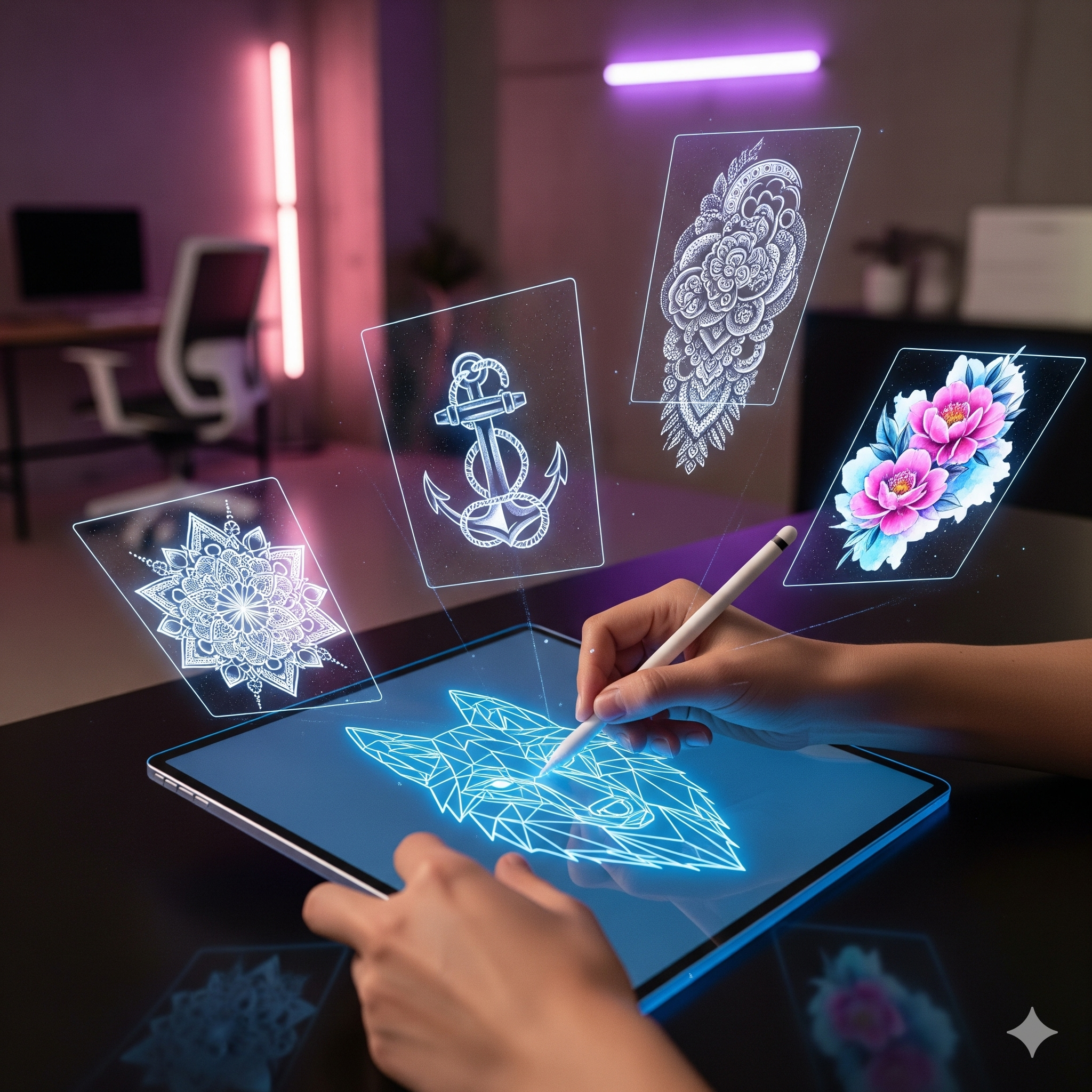
Have you ever looked at the ink on your skin and imagined it moving? Imagine the dragon on your back breathing actual fire, the koi fish on your arm swimming through a stream of ink, or the geometric mandala on your chest pulsing in sync with your heartbeat.
For decades, tattoos were defined by their permanence and their stillness. They were static snapshots of a moment in time. But in 2025, the boundaries of body art have shattered. Thanks to the explosion of Generative AI (Artificial Intelligence) and Motion Design technologies, transforming a static tattoo into a mesmerizing animation is no longer a sci-fi dream—it is a reality accessible to everyone, usually in under 30 seconds.
Whether you are a professional tattoo artist looking to skyrocket your engagement on Instagram Reels, or an ink enthusiast wanting to see your art in a new dimension, this guide is the only resource you will ever need. We will cover technical preparation, AI tools, and when you should upgrade to a human expert for complex projects.
On this page
Why Animate Your Tattoo? The "Viral" Revolution of 2025
Before diving into the "how-to," it is crucial to understand the "why." Why are top tattoo artists and influencers shifting massively toward animated content? The answer lies in the algorithms of social media giants like Instagram, TikTok, and YouTube Shorts.
1. The Death of the Static Photo
Social media algorithms have changed. Today, platforms prioritize Watch Time (how long a user lingers on your post). A static photo is consumed in 0.5 seconds. The user scrolls past instantly.
An animated tattoo, however, creates a "Visual Hook." The movement catches the peripheral vision, stopping the scroll. Users watch the animation loop 2 or 3 times to understand what they are seeing. This signal tells the algorithm: "This content is engaging," resulting in up to 500% more reach than a standard photo.
2. Enhanced Storytelling
A static image shows the result. An animation shows the intent. By animating the water around a ship or the wind in a portrait's hair, you are not just showing a drawing; you are immersing the viewer in the atmosphere and emotion of the piece. You are telling a story that a JPEG simply cannot convey.
Step-by-Step Tutorial: From Skin to Screen
Creating a professional-quality animation requires more than just clicking a button. The AI is powerful, but it needs good input data. Follow this detailed protocol to ensure your result is crisp, realistic, and free of artifacts.
Step 1: Mastering the Source Photo (Crucial)
90% of failed animations are due to a bad input photo. The AI needs to clearly distinguish between the ink, the skin texture, and the volume of the muscle.
- Lighting is Key: Avoid direct flashes. Flash creates "specular highlights" (white shiny spots) on the fresh ink or moisturized skin. These white spots confuse the AI, which interprets them as part of the design. Instead, use soft, diffused natural light—ideally standing next to a large window on an overcast day.
- The "Parallax" Problem: Take the photo directly perpendicular to the tattoo. If you take the photo from a steep angle, the AI will try to animate a distorted image, resulting in a "warped" animation that looks unnatural.
- Resolution and Focus: Use the main camera of your smartphone (not the selfie camera). Ensure the tattoo is perfectly in focus. If your phone has a "Macro" mode, use it for smaller, detailed pieces. The sharper the lines, the better the AI can detect the edges.
Step 2: Selecting Your Animation Engine
On platforms like EncreVive, you aren't just applying a generic filter. You must choose an animation logic that matches the style of your tattoo.
Fluid Dynamics
Best for: Japanese traditional (waves, clouds), watercolor styles, biological elements (hair, smoke, fire).
How it works: The AI simulates liquid physics. It pushes pixels along a path that mimics how water or smoke behaves in the real world.
Rhythmic Pulse
Best for: Mandalas, Dotwork, Sacred Geometry, Cyberpunk styles.
How it works: Isolates layers and applies expansion/contraction effects. It gives the impression that the tattoo is "breathing" or glowing.
Parallax/3D
Best for: Realism and Portraits.
How it works: Creates a "depth map," guessing which parts are closer and further, allowing for a slight 3D movement without distortion.
Step 3: The AI Processing Phase
Once you upload your photo, what happens behind the scenes?
- Segmentation: The AI separates the tattoo pixels from the skin pixels.
- In-painting: It calculates what is "behind" the moving lines to fill in the gaps when the ink moves.
- Frame Interpolation: It generates 30 to 60 new frames between your static image to create smooth motion.
This process typically takes between 15 and 45 seconds depending on server load and complexity.
The "Uncanny Valley": When AI Fails (and What to Do)
While AI is miraculous for 80% of cases, it has significant limitations. Recognizing these limitations is what separates a professional result from a messy gimmick.
The Problem with Anatomy
AI operates on a 2D plane (your photo). It does not fully understand the 3D cylinder of an arm or the complex curvature of a collarbone.
- The Glitch: If you try to animate a tattoo that wraps around a limb (like a full sleeve), the AI might distort the edges of the arm, making the background warp along with the ink. This breaks the immersion immediately.
- The Complex Narrative: AI cannot understand complex instructions like "I want the snake to slither down the arm, then open its mouth." AI generates loops; it does not direct movies.
The Solution: The Human Expert (The "Pro" Tier)
For complex projects—full back pieces, sleeves, or narrative animations—you need a human touch. A professional Motion Designer does not just use filters.
- Rigging: They create a virtual skeleton for the tattoo character.
- Masking: They manually separate the tattoo from the skin frame by frame (Rotoscoping) to ensure the background never warps.
- VFX: They add particle effects, custom lighting, and sound design that AI cannot match.
Comparison: AI Generator vs. EncreVive Expert Studio
| Feature | AI Generator (Free/Basic) | Human Expert (Premium) |
|---|---|---|
| Complexity | Simple Loops (Water, Fire, Glow) | Narrative Scenarios & Morphing |
| Anatomy | 2D only (Flat surfaces best) | Full 3D understanding (Sleeves, Body) |
| Resolution | 1080p (Social Media) | 4K (Broadcast/Commercial Quality) |
| Control | Random/Generative | Precise Creative Direction |
| Best For | Daily Posts, Stories, Fun | Portfolio Pieces, Ads, Memory Preservation |
Do you have a complex project? Don't risk a glitchy result. Browse our Directory of Certified Motion Designers and commission a bespoke animation.
Beyond the Screen: The Future of Animated Ink
We are currently in the early stages (the "Gen 1") of tattoo animation. What does the near future hold?
Augmented Reality (AR) Filters
Imagine pointing your phone camera at your friend's arm, and the tattoo instantly starts moving on your screen, locked perfectly to their skin even if they move. This technology, known as Target Tracking, is becoming accessible. You can now commission custom Instagram/TikTok filters (Spark AR) triggered specifically by your unique tattoo.
Project Mapping on Skin
For events, conventions, or artistic performances, artists are now using "Projection Mapping." By using a projector linked to a camera, they can project the animation directly onto the skin in real-time. The tattoo appears to move in real life, not just on a phone screen.
FAQ: Common Questions about Tattoo Animation
Does animation work on old, faded tattoos?
Yes. In fact, AI often enhances them. Because the AI looks for contrast, it can isolate the original pigment. Many users use animation to "preview" what a touch-up (blast over) might look like, or simply to give new life to a 20-year-old piece.
Can I use these animations for my Tattoo Artist Portfolio?
Absolutely. It is highly recommended. Clients love to see how a design "flows." Posting an animation of a flash sheet significantly increases the likelihood of it being booked. It creates a "Scroll-Stopper" effect in a saturated feed.
Is there a copyright issue?
Legally, the animation is considered a "derivative work." If you are the tattoo artist, you own the design. If you are the client, you have the right to display images of your body. However, if you plan to sell the animation as an NFT, it is best to have a clear agreement between artist and client.
Ready to transform your ink?
Don't let your masterpiece stay static. Join the revolution of digital body art today.