Category: Guides & Advice / Business | Reading time: 12 minutes | Date: December 14, 2025
It's 2025. The tattoo industry has changed more in the last 24 months than in the previous two decades. Generative tools like Midjourney v7, DALL-E 4, or Adobe Firefly integrated into Photoshop have become terrifyingly precise. They no longer just make abstract blobs; they now perfectly handle the codes of Traditional, the gradients of Realism, and even the line consistency of Fineline.
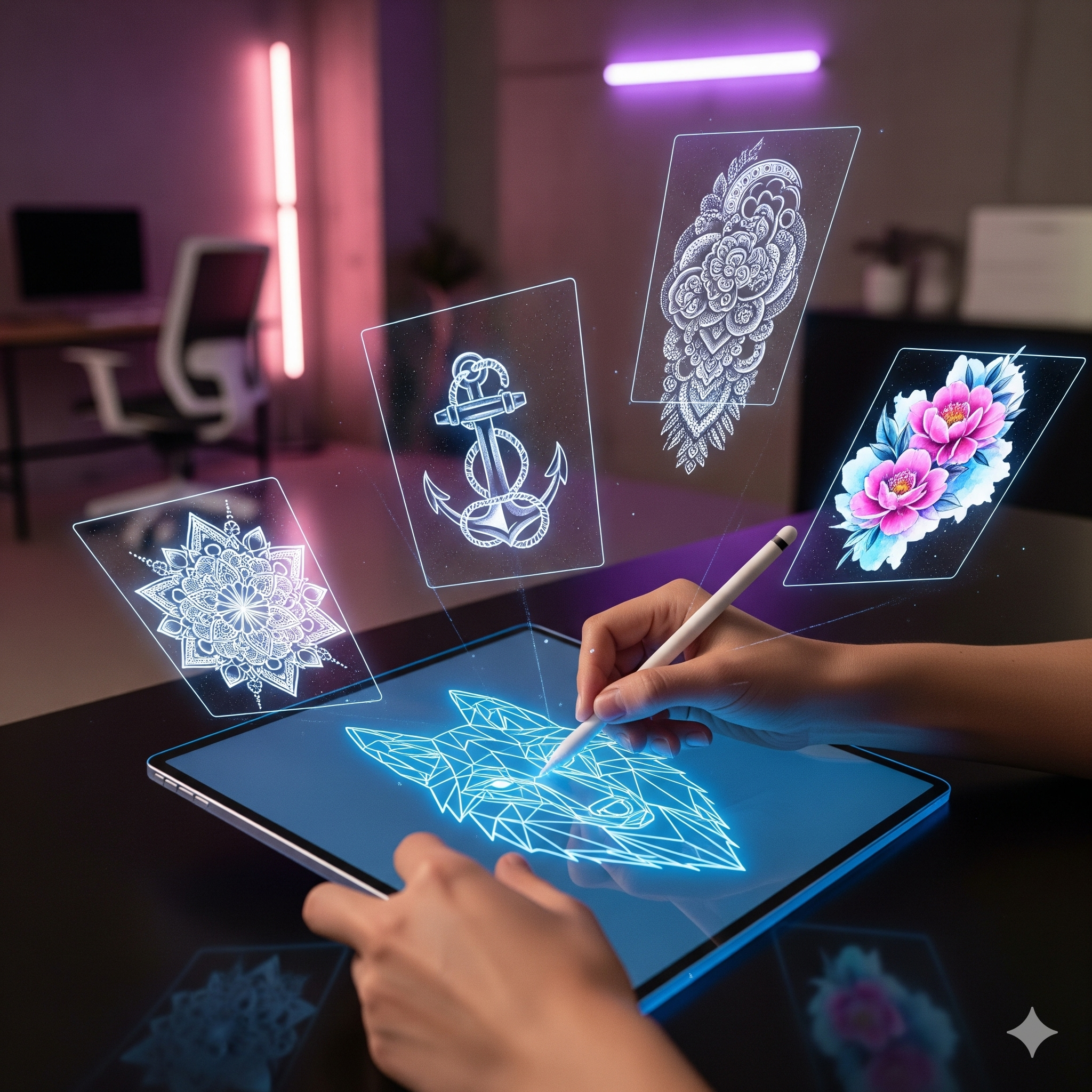
For a professional tattoo artist, the temptation is immense, almost irresistible. Why spend 4 to 6 hours drawing a complex composition for a full sleeve, when AI can propose 20 stunning variations in less than 10 minutes? Productivity explodes, mental fatigue decreases.
But when presenting the project to the client, often during the appointment or a few days before via DM, a malaise sets in. The client discovers the design, their eyes light up, and they exclaim:
"Wow, that's incredible! You captured exactly what I had in mind. It's beautiful, you must have spent all night on it."
At that precise moment, time freezes. Two choices are available to you:
- The Complicit Silence: Nod, smile humbly, accept the compliment (and the deposit) while letting the client believe your hand traced every line.
- The Risky Truth: Admit that 90% of the visual structure was generated by an algorithm, and that you intervened for "artistic direction".
This is the most burning ethical gray area of our industry at the end of 2025. To understand the real stakes – which go beyond simple "cheating" – let's start with a true story that shook the Parisian community last month.
Case Study: The "Dragon Scandal" in the 11th Arrondissement
To preserve her anonymity and her shop's reputation, we will call this tattoo artist "Léa". Léa is a resident artist in a reputable studio near Bastille, known for her Neo-Japanese style and mastery of vibrant colors. She has been tattooing for 8 years, her manual talent is undeniable.
But like many, Léa is overwhelmed. Her agenda is full for 6 months, she manages her social media, her accounting, and her private life. Fatigue accumulates. To "optimize" her preparation times (the famous unpaid invisible work), she integrated AI into her workflow intensively in late 2024.
The "Unique Piece" Incident
A client, Thomas (name changed), orders a large project: a Japanese dragon (Ryu) wrapped around a traditional dagger, with specific peonies in the background. Thomas insists that he wants a unique work, symbolizing a personal fight against illness. He pays a substantial deposit.
Léa uses an advanced AI to generate the composition. The result is breathtaking, far beyond what she could have sketched in two hours. She barely retouches a few scales on Procreate to clean up the image, prints the stencil, and tattoos Thomas. The session lasts 6 hours, the technique is perfect, the client is delighted. He posts the photo everywhere on Instagram and TikTok.
The Algorithmic Cold Shower
Three days later, the drama explodes. Thomas receives a message from a friend who follows "AI Art Inspiration" accounts. He sends him a link. On the screen, Thomas discovers an image 95% identical to his tattoo. Not similar, not inspired by, but almost identical. The AI used by Léa had dipped into a very popular public database, and this precise design had already been "liked" thousands of times.
Thomas felt betrayed. He did not question the technical quality of the inking – which was objectively excellent – but the value of the human exchange. He sent a scathing email to the shop:
"I paid €250 in design fees for a work you sold me as personal. In reality, I feel like I bought an industrial sticker that anyone can download. You lied to me about the origin of my tattoo."
Léa had to refund part of the service to avoid a lawsuit, but the damage was done. Local rumor transformed the story: "Léa doesn't draw anymore, she prints from the Internet." An unfair exaggeration, but devastating.
The lesson? It wasn't the tool that hurt the client. It was the lack of transparency and the breach of trust.
The Financial Dilemma: What is the client really paying for in 2025?
The main argument of tattoo artists who choose opacity is often financial. There is a visceral fear: if the client knows the drawing took 15 minutes instead of 5 hours, will they still agree to pay the "drawing fees"?
It's a misunderstanding of the economic value of art. We need to change the paradigm.
The Locksmith and Expert Analogy
Imagine you lock yourself out with the keys inside. You call an emergency locksmith. He arrives, takes out a specialized tool, and opens your door in 30 seconds. He charges you €150. Are you going to tell him: "That's theft, it took you 30 seconds, I'll give you €2"? No. You are not paying for the 30 seconds of execution. You are paying for the 10 years of experience that allow him to solve your problem in 30 seconds without breaking the lock.
With Generative AI, it's the same logic. If you use AI, the client no longer pays you for your hours of sketching, but for:
- Your Artistic Direction (A.D.): Your ability to write the perfect "Prompt", to know artistic references, and to guide the machine.
- Your Curation: AI generates a lot of garbage. Your expert eye allows you to choose THE right version among 50 failed attempts.
- Your Technical Expertise: Knowing immediately if an image is "tattooable" or not (contrast management, space for aging).
Recommended external link: Understanding pricing psychology in artistic services (Harvard Business Review or specialized marketing blog)
The Legal Gray Area: Who owns the design?
This is the most unknown and dangerous aspect for tattoo artists in 2025. According to current laws in the United States (US Copyright Office) and the trend in Europe, a work generated 100% by an AI is not copyrightable. It belongs to the public domain.
This means two serious things:
- Absence of Exclusivity: If your client crosses paths with another person with exactly the same tattoo (generated by the same AI with a similar prompt), you can do nothing. You sold an "exclusivity" that you did not legally possess.
- Right to Copy: If a clothing brand takes your AI-generated design and puts it on T-shirts, you cannot sue them for counterfeiting, unless you modified the image significantly (human intervention).
If you do not tell your client that the design is from AI, you expose them to these legal risks without their consent.
Recommended external link: INPI guide or legal article on copyright and AI
The Technical Reality: Why AI (Still) Can't Tattoo
This is the ultimate argument to absolve yourself of using these tools. An AI-generated image is not a tattoo. It is a digital illustration, often anatomically aberrant.
If you show a raw Midjourney design to a client claiming it's the final drawing, you are technically lying. Why?
- The "Plastic Skin" Problem: AI tends to create smooth, shiny skin textures without pores. It looks nice on screen, but impossible to reproduce with ink.
- Aging: AI loves micro-details. However, we all know that ink spreads slightly under the dermis over the years. A raw AI design will become an illegible black blob in 5 years.
- Body Flow: AI draws on a flat 2D rectangle. It doesn't understand that an arm is a conical cylinder, that muscle moves, or that a clavicle deforms the design.
Therefore, human intervention remains mandatory. It's the "Redraw" (drawing over it). That's when you bring your value. You transform a virtual image into a technical blueprint for the skin.
The Transparency Strategy: 3 Methods to Announce It
Should you say it? Yes. Should you say it apologetically? Absolutely not.
Opacity is dangerous in the age of social media. Everything eventually comes out (like for Léa). Here are three concrete approaches to present AI to your clients without devaluing your work, but by enhancing it.
1. The "Collaborative" Approach (Most Recommended)
Present AI as an interactive brainstorming tool, a super-assistant.
The script: "For your project, I used a generation engine to explore several visual paths quickly. I came up with these 4 different moods. Which one speaks to you the most? Once you've chosen the direction, I redraw everything by hand on iPad to adapt it to your morphology."
The effect: The client feels involved in the creative process. They see AI as a bonus that gives them choice, not as a lazy shortcut.
2. The "Moodboard" Approach (Safest)
Never use AI for the final design, but only to create mood boards and references.
The script: "I haven't drawn the final tattoo yet, but here is a collage of inspirations I generated to validate the atmosphere, light, and elements. If we agree on this moodboard, I move on to the technical drawing."
3. The "Tech-Forward" Approach (The Future?)
Some avant-garde artists now proudly display "AI Assisted Tattoo Artist" in their Instagram bio. They attract a "Tech" or "Cyberpunk" clientele looking precisely for this slightly surreal, glitched aesthetic peculiar to AI. For them, AI is an artistic signature, not a shame.
Conclusion: Honesty Pays (Literally)
Let's go back to Léa. After her "bad buzz" and a period of questioning, she radically changed her marketing strategy.
Today, she offers two clear rates on her site:
- The "Pure Craft" Rate: 100% hand-drawn, longer, more expensive, for purists.
- The "Hybrid Design" Rate: Designed with AI and retouched, faster, slightly cheaper.
Guess what? The Hybrid option now represents 70% of her turnover. Clients are not against technology. They just want to know what they are buying. They accept AI if it allows for a cool design faster, as long as the tattoo artist is honest about the process.
In 2025, your added value is no longer just your pencil stroke (AI does it), it's your expert eye, your ethics, and your mastery of the needle. Don't be afraid to say you use modern tools. Be afraid of making believe you are a machine, when your greatest strength remains, ultimately, being human.
To go further
Read also: How to Animate Your Existing Tattoo with AI: The Ultimate 2025 Guide
Read also: Will AI Kill the Tattoo Profession? Our Investigation
Recommended tool: Test Midjourney or BlackInk AI for your moodboards.
Liked this article? Share it with a tattoo artist colleague who is still hesitating to take the plunge into AI.