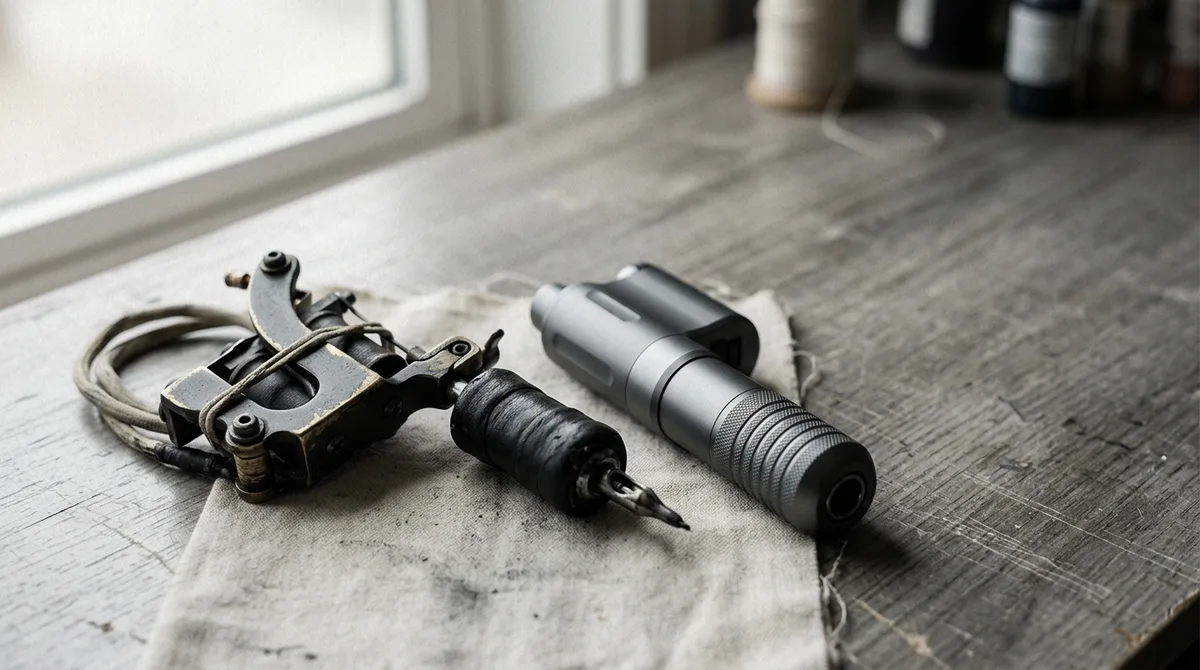
In studios, people say « apprentice ». In French law, the word means something else, and the gap is not trivial. An apprenticeship contract is a precise employment contract, with a salary, a training centre and a diploma at the end. None of that exists for tattooing. The person learning in a studio is therefore, depending on the case, an intern, an employee, an independent or on an immersion, and each of these statuses has its rules. This article sets them out one by one, then recalls what stays mandatory before the first needle, whatever the status. The full path is in « Becoming a tattoo artist in France in 2026 ».

Why the tattoo apprenticeship contract does not exist
Article L6211-1 of the Labour Code gives apprenticeship a precise object: a professional qualification sanctioned by a diploma or a title registered in the national register of professional certifications. Article L6221-1 defines the contract that goes with it: an employment contract of a particular kind, where the employer pays a salary and provides training delivered partly in the company and partly in an apprentice training centre.
Tattooing meets none of these conditions. There is no state diploma for tattoo artists, the Public Health Code requires none, and the only certification registered for this activity, RS6939, covers hygiene and sanitation, not the trade. With no diploma or title to prepare, there is no apprenticeship contract, no apprentice training centre, no apprentice status. The word survives in usage, not in law.
What an « apprentice » is legally: four possible situations
| Situation | What the law provides | Text |
|---|---|---|
| Intern | Reserved for pupils and students, within a curriculum, with an agreement signed by the educational institution, the intern and the host. Without enrolment in an institution, no internship. | Education Code, L124-1 |
| Studio employee | Employment contract, declaration, payslip, pay at least equal to the legal minimum wage. The studio is the employer, with the obligations that go with it. | service-public, minimum wage |
| Independent in collaboration | Own status, most often a micro-entreprise under BNC, invoicing the studio or the clients. A registered person is presumed not to be an employee, unless there is a « permanent legal subordination » to the principal. | Labour Code, L8221-6 |
| On professional immersion | Period of immersion in a professional environment, one month at most per agreement, for a job seeker or a person retraining, benefits maintained, no pay from the studio. | service-public, sheet F14102, verified 20 March 2026 |
One line is missing from this table, deliberately: the « volunteer » who works for months in a studio with no status. French labour law does not recognise volunteering for the benefit of a business. A person who greets clients, prepares stations, cleans and draws under the studio's instructions, at hours set by it, is in a relationship of subordination. If that person is neither declared nor paid, article L8221-5 qualifies the situation as concealed work through concealed employment, and the studio answers for it. The goodwill of both parties changes nothing about the qualification.
Pay: what the law says, what the market does
There is no pay scale for tattoo apprentices, for the reason seen above: there is no apprentice in the legal sense, so no scale. What exists depends on the status chosen. An employee receives at least the legal minimum wage, whatever the name given to the position. An independent invoices what was agreed by contract, and passes on a share to the studio where applicable. A person on immersion keeps their benefits and is not paid by the host. An intern falls under the Education Code's rules on internship allowances, reserved for students.
The market, for its part, often practises unpaid apprenticeship, sometimes paid-for. This article publishes no amount: there is no source for it. It only recalls the line: the more the studio sets the hours, the tasks and how they are performed, the more the relationship looks like a job, and the more the absence of a contract and a salary exposes the studio.

Before touching skin: the same obligations as the established artist
The status changes nothing about what the Public Health Code requires from « any person who performs » a tattooing technique. Articles R1311-1 to R1311-13 require the hygiene and sanitation training, today ending in a certification delivered by the ARS, the declaration of the activity to the director general of the ARS, compliant products and client information. These obligations are personal: the certification and declaration of the artist who trains do not cover the person being trained. Nor does the text make invoicing the condition of these obligations. The detail of the training is in « Tattoo hygiene and sanitation training in France ».
Before that step, everything that does not touch skin remains free: drawing, observation, station preparation, synthetic skin. That is what professional immersion allows, and it is also the part of an apprenticeship a studio can entrust to someone not yet certified.
Finding a studio: what to ask, and to write down
Most bad apprenticeship experiences come from the absence of anything in writing. Whatever the status, a document signed before the first day avoids most disputes. It states:
- the status chosen among the four above, and the papers that go with it, agreement, employment contract or collaboration contract;
- the duration, days and hours of attendance, and what ends the relationship;
- the content: what is passed on, at what pace, and from when the person tattoos, once certified and declared;
- the pay or its absence, any revenue shares, and who pays for equipment and consumables;
- the fate of the drawings made during the period, and the use of photos;
- the health obligations: hygiene training before any act on skin, personal ARS declaration, single-use equipment.
A studio that refuses to write these points down already says something about the relationship it offers.
About this article
Marc Vernes is neither a lawyer nor a labour inspector. This text describes the French framework in force at its update date, from the texts cited: Labour Code (articles L6211-1, L6221-1, L8221-5 and L8221-6), Education Code (article L124-1), Public Health Code (articles R1311-1 to R1311-13), service-public sheets F14102 (verified 20 March 2026) and F2300. It qualifies no individual situation: an ongoing contract or a dispute is handled with a lawyer or the labour inspectorate.
Last updated: September 2026.
What a studio looks at before saying yes
Before the status and the contract, there is the moment a tattoo artist opens your portfolio. A piece that moves gets noticed where a photo gets forgotten, and your drawings do not need to be on skin to be animated.
On our side, animating one piece costs 10 credits. The €7.99 pack contains 45, which is four animations.
Create my accountThe 3 credits given at sign-up cover design generation, not animation.