
Three questions come up for everyone looking for tattoo artist training in France: is there a CAP, do you have to go through a school, how much does it cost. The answers fit in three sentences. There is no state diploma. One course is mandatory, hygiene and sanitation, and it does not teach tattooing. Everything else, schools, workshops, mentorships, is a private market with free prices that nobody controls. This article details each answer, then what can actually be funded. The full path, status and declaration included, is in « Becoming a tattoo artist in France in 2026 ».
There is no CAP for tattoo artists, and no state diploma
Tattooing is regulated by articles R1311-1 to R1311-13 of the Public Health Code. They require a declaration to the regional health agency, a hygiene and sanitation course, compliant products and client information. No article requires a diploma, a title or attendance at a school. The service-public sheet « Tatouage : quelles sont les règles ? », verified on 13 November 2025, mentions nothing else.
The only state-registered certification covering this activity is certification RS6939, « Certification aux conditions d'hygiène et salubrité pour la réalisation des techniques de tatouage et du perçage corporel », whose certifier is the ministry in charge of health. It covers hygiene, not the craft, and it is not a tattoo artist title. That is also why no tattoo apprenticeship contract exists: the Labour Code reserves apprenticeship to qualifications leading to a diploma or title registered in the national register, a question covered in « Tattoo apprentice in France ».
When a school announces a « tattoo artist diploma », it is a private document issued by the school itself. It may attest to real work. It has no regulatory value, and it replaces neither the hygiene certification nor the ARS declaration.
The only mandatory course: hygiene and sanitation, 21 hours
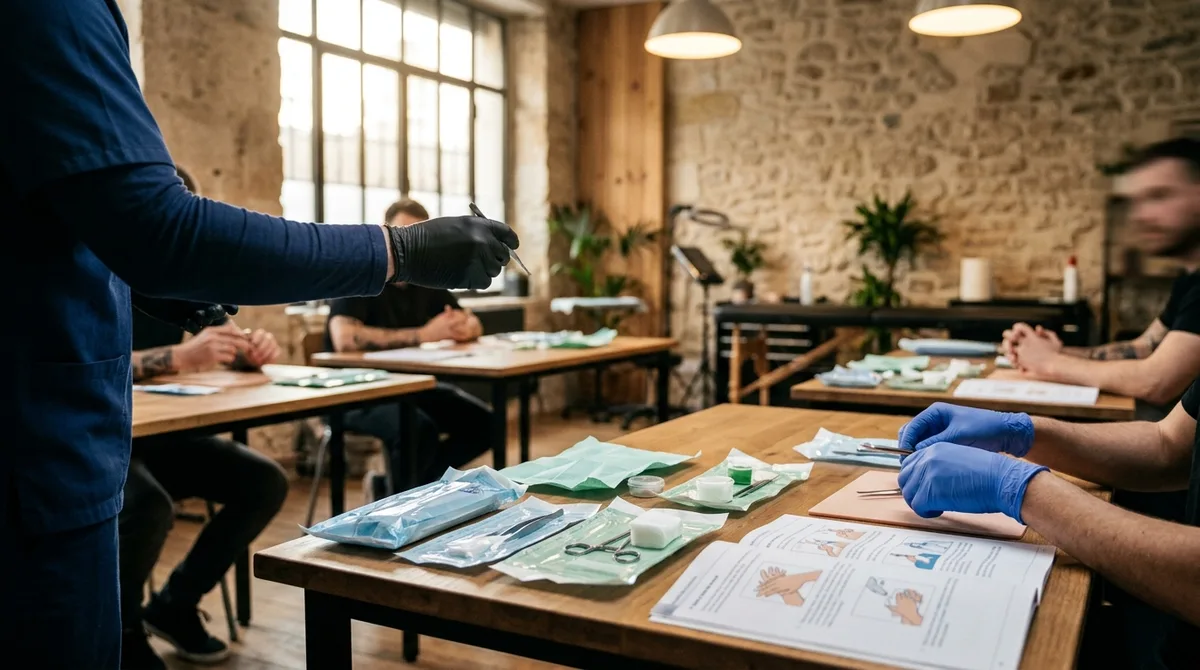
The order of 5 March 2024 sets the course required by article R1311-3: a minimum of twenty-one hours spread over three days, seven of them devoted to practical training (article 1), delivered by an ARS-accredited body, and ending in a certification delivered by the ARS on a jury's proposal, valid for five years (article 2). The detail of the framework, the tests, the renewal and the fate of older attestations is in « Tattoo hygiene and sanitation training in France ».
Two points to keep here. This course contains no hour of tattooing on skin: the seven practical hours cover hygiene, sterilisation, skin preparation, waste. And it is the only one whose price can be covered by the public schemes described below, because it is the only one that is registered.
Schools and craft training: a private market, free prices
Learning to tattoo happens in a studio, with an established artist, or in a private school. Neither is framed by any text: no imposed curriculum, no minimum duration, no accreditation, no regulated price. This article therefore publishes no fee: there is no official source to give one, and amounts vary from one body to another without anything justifying them.
What can be checked, however, before paying:
- Who teaches: a working tattoo artist, declared to the ARS, whose work and studio you can see.
- Real time on skin: synthetic skin first, then human skin, and under what hygiene and supervision conditions.
- What former students become: do they tattoo today, where, since when. It is the only outcome indicator that exists.
- What is written: duration, content, cancellation terms, status during the training.
- The separation from the hygiene certification: a school may also be an accredited body for the hygiene and sanitation course, or not. The document it issues at the end of its programme is not certification RS6939.

Online training: possible for theory, not for the certification
Online courses exist for drawing, composition, knowledge of equipment. Nothing forbids them. But the mandatory course cannot be followed entirely online: article 1 of the order of 5 March 2024 requires seven hours of practical training, and the RS6939 sheet provides for a final written test and a practical assessment validating each unit. An entirely online offer promising the hygiene and sanitation certification cannot deliver it. The check is simple: on moncompteformation.gouv.fr, the session must be attached to code RS6939 and the body accredited by an ARS.
Funding the training: CPF, France Travail, other funders
| Scheme | What it covers for a future tattoo artist | Source |
|---|---|---|
| Personal training account (CPF) | The hygiene and sanitation course, because its certification RS6939 is registered in the specific register. Coverage capped at €1,500 for these certifications since 26 February 2026. | Decree no. 2026-127, article D6323-1 A of the Labour Code |
| Individual training aid (AIF), France Travail | The tuition costs of a course validated in the personalised return-to-work plan, for a registered job seeker, receiving benefits or not. On a quote from the body, decided by the adviser. | France Travail, AIF sheet |
| Professional immersion | A period in a studio of one month at most, under an agreement, benefits maintained. It is not training, it is the legal way to observe the trade before investing. | service-public, sheet F14102, verified 20 March 2026 |
| Other funders | Above the CPF cap, the remainder is paid by the account holder or a third-party funder: employer, State, region, skills operator, depending on the situation. | moncompteformation.gouv.fr |
Two clarifications. The CPF is a national account attached to the person, it does not depend on the region. And France Travail's aid assumes the course is consistent with your return-to-work plan: the AIF sheet mentions no amount, the decision belongs to the adviser. A private tattoo school, not registered, falls under none of these schemes by right; some are listed by France Travail, which is checked with the adviser before signing.
What the training does not settle
Once trained, you still have to create the status, a micro-entreprise under BNC for the vast majority, declare the activity to the director general of the ARS of the place of practice, and comply with the rules on inks, equipment and client information. These steps, with their texts, are in « Becoming a tattoo artist in France in 2026 ». The tax framework, BNC and not BIC, is in « Tattoo artist: BIC or BNC? ».
About this article
Marc Vernes is neither a training body nor a France Travail adviser. This text describes the French framework in force at its update date, from the texts cited: Public Health Code (articles R1311-1 to R1311-13), order of 5 March 2024, France compétences sheet RS6939, decree no. 2026-127 of 24 February 2026, France Travail and service-public sheets F14102 (verified 20 March 2026) and F22481 (verified 13 November 2025). It recommends no school and no body. For your own situation, your France Travail adviser and your ARS are the contacts.
Last updated: September 2026.
What no training delivers: a portfolio that stands out
The mandatory course makes you legal, the school or the studio makes you able. What gets you noticed by a first studio or a first client is what people see of your work. A piece that moves gets noticed where a photo gets forgotten.
On our side, animating one piece costs 10 credits. The €7.99 pack contains 45, which is four animations.
Create my accountThe 3 credits given at sign-up cover design generation, not animation.