Back tattoo ideas for women: shoulder blades and central designsA central axis or a curve across the shoulder blade.
Compare back tattoos for women with a shoulder-blade branch, an open flower, a tree or a vertical ornament. Choose the starting point and overall area before bringing several elements together.
More about this selection
You often view your back through a photograph or mirror. Prepare several views with your artist, arms relaxed and in a natural moving position. Straps and necklines also provide useful references for visibility.
Back tattoo ideas for women: shoulder blades and central designs on skin
Light, medium and dark skin tones, different proportions and placements: compare how each motif sits on the body. These images are simulations created with our AI.
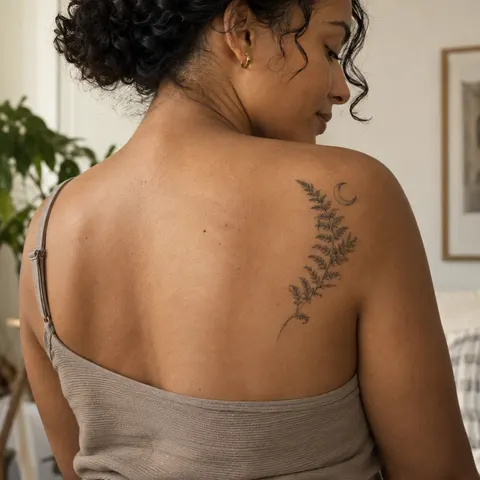
Fern and moon on the shoulder blade
The fern curves along the shoulder blade; the moon stays separate from the leaves.
PersonaliseShoulder-blade garden
A peony and ferns sit on the shoulder blade. A localised piece leaves room for other motifs.
PersonaliseLace-like ornament
Symmetry establishes a centre. Small details surround a clear structure without overlapping.
PersonaliseMore designs to explore
Try another direction: start with a line, a silhouette or a colour, then adapt the design in the studio.
One large elegant peony bloom with flowing botanical leaves
PersonaliseA young tree with three main branches
PersonaliseAn open-winged butterfly in fine black linework
PersonaliseA slender fern with spaced leaves
PersonaliseA symmetric ornament of arabesques and points with a central pendant
PersonaliseA tree of life with a black trunk and a canopy divided by white spaces
PersonaliseTurn a reference into your own project
A shoulder-blade motif creates an offset composition; a central back axis organises the elements differently. A branch can follow the shoulder curve while a tree develops a wider canopy. Compare the directions before settling on a subject.
You often view your back through a photograph or mirror. Prepare several views with your artist, arms relaxed and in a natural moving position. Straps and necklines also provide useful references for visibility.
Explore tattoo meanings →Three directions to compare
The main outline
Start with the outer shape. Choose what you want to keep before adding lettering or secondary elements.
Explore this direction →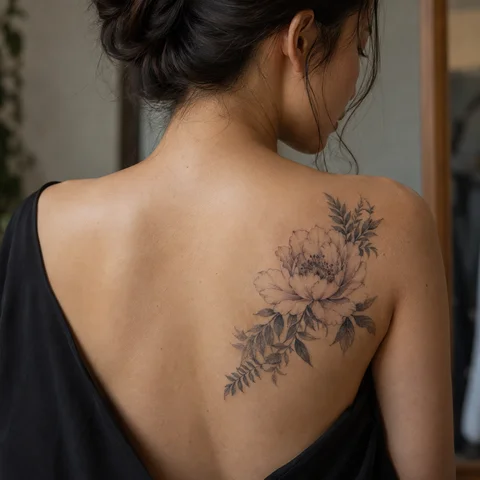
The contrast
Compare the dark lines with the open spaces. Ask your artist which details suit your intended size.
Explore this direction →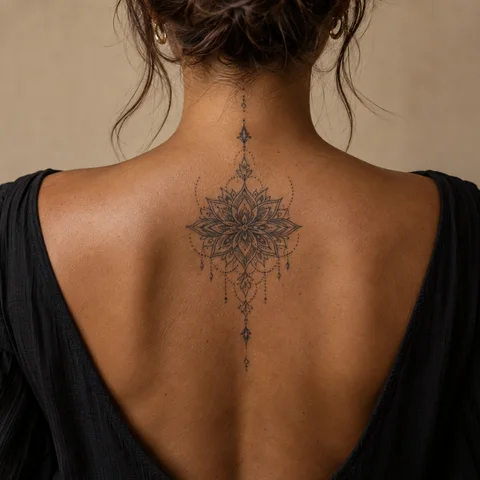
The placement
Look at the same reference at its actual size and from several angles. The placement is part of the composition.
Explore this direction →Where should your tattoo go?
Shoulder blade
A flower or branch can stand alone in an offset position.
Central axis
A vertical ornament calls for checking its alignment and ends.
Full back
For an extended composition, define the main subject before the background.
Choose a composition for your back
A curved branch
A fern or flower stem follows a light direction. Let leaves remain separate instead of filling every gap.
A central motif
A rosette or tree can structure a symmetrical piece. Compare its width with the shoulders.
An open composition
Several spaced elements can create movement without framing the whole area. Plan connections if you may add to the project.
Prepare your reference for the artist
Keep two or three references and note exactly what you want to retain from each. Specify placement, approximate dimensions and any existing tattoos nearby.
If the design includes letters or a date, prepare the exact text separately. AI images are starting points for discussion, not validated stencils or predictions of the final result.
More directions for your project
From the first design to your appointment
Clarify your reference
Keep a few images and explain what you like about each: the subject, linework, scale or placement. A reference starts a conversation; it is not a finished stencil.
Choose an artist for the style
Look at the artist’s own work, including healed examples where available. Discuss the intended dimensions, placement and any text before requesting a quote.
Check the final drawing
Review the stencil at its actual size and in several natural positions. Read names and dates character by character before approving them.
Prepare the appointment and aftercare
Ask your tattoo artist for preparation and aftercare instructions tailored to the session. The images here cannot determine what is suitable for your individual skin.
What if your next tattoo
started with your words?
Choose a direction, change a detail and create your own reference with Encre Vive.
Create my tattooView plans and creditsYour questions answered
01Shoulder blade or spine: how do I choose?
The shoulder blade allows an offset placement; the spine suggests a central axis. Compare the design’s outline in both positions rather than looking at the motif alone.
02How can I check a tattoo I cannot see directly?
Ask for straight-on and three-quarter views of your back with a full-size reference. Check its edges against clothes you wear often.
03Can I start small and extend it later?
Yes. Tell your artist so that the composition retains useful directions and spaces for future additions.
04How do I personalise a reference?
Choose a model to open the generator with its subject and style. Change the description before generating and check any letters or numbers in the result.
05Are the tattoos in the photographs real?
The photographs are AI-generated simulations. Lettering studies show example layouts; all references need adapting with a tattoo artist.
06How much should I budget?
Ask an artist for a quote based on the dimensions, placement and detail of your project. The gallery cannot determine the cost of your session.