Tattoo placement ideasOne design, different ways to wear it.
Compare tattoo placements by visibility, shape and available space. From the wrist to the thigh, these on-skin simulations help you choose an area before refining the design with your artist.
More about this selection
The outline offers another starting point. A long branch can follow a forearm or lower leg, while an open flower can sit over the shoulder. Compare two areas with a mock-up at the same scale, then have the artist adapt the proportions to your body.
Tattoo placement ideas on skin
Light, medium and dark skin tones, different proportions and placements: compare how each motif sits on the body. These images are simulations created with our AI.
Chrysanthemum shoulder cap
Rounded petals and leaves follow the shoulder. Muted red and black contours create a focal point while leaving the upper arm open.
PersonaliseFine-line flower
A stem and a few petals define the motif. Discuss the scale and spacing with your artist.
PersonaliseSnake and ginkgo
A winding silhouette moves between fan-shaped leaves. Open spaces separate the curves along the outer thigh.
PersonaliseCurved olive sprig
A small branch curves above the ankle. Its open end keeps the motif separate from the outline of the foot.
PersonaliseIrises along the spine
A long stem links two irises and a few leaves. The design follows the height of the back with open skin on either side.
PersonaliseA sprig beneath the hairline
A small branch sits below the hairline. Its compact height provides a comparison with designs that extend onto the upper back.
PersonaliseMore designs to explore
Try another direction: start with a line, a silhouette or a colour, then adapt the design in the studio.
One short olive twig with six simple leaves
PersonaliseA sprig of lavender and a chamomile flower intertwined beneath a small crescent moon
PersonaliseA symmetric mandala with a dotwork gradient
PersonaliseOne large elegant peony bloom with flowing botanical leaves
PersonaliseA hannya mask surrounded by peonies and maple leaves
PersonaliseOne small ocean wave
PersonaliseChoose an area that fits your everyday life
Start with what you want to see yourself and show to others. A wrist tattoo accompanies your gestures; a back piece appears with particular clothes. A tiny neck motif can be more noticeable than a large thigh composition. Size alone does not determine discretion.
The outline offers another starting point. A long branch can follow a forearm or lower leg, while an open flower can sit over the shoulder. Compare two areas with a mock-up at the same scale, then have the artist adapt the proportions to your body.
Explore tattoo meanings →Three directions to compare
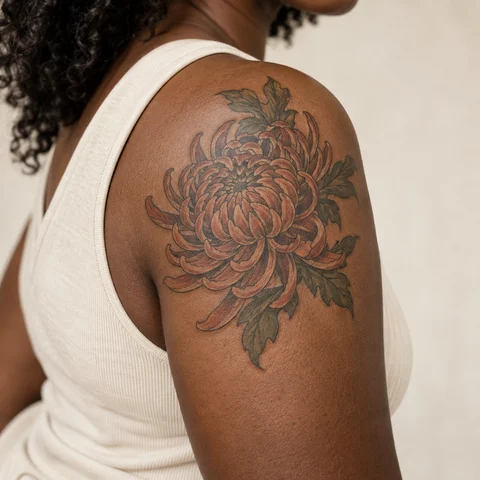
Curves and colour
A shared movement links petals and leaves. Keep one focal point and distinct outlines.
Explore this direction →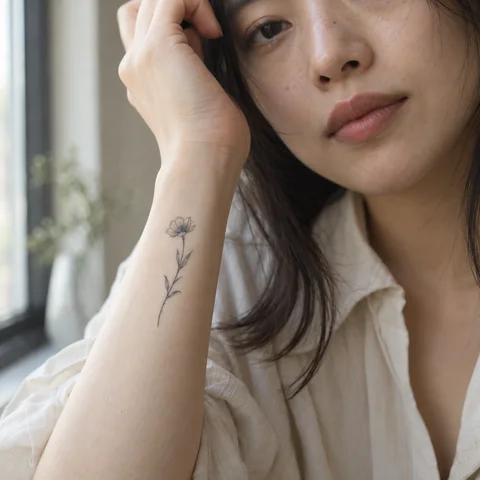
Fine lines and open space
Compare the main outline and the gaps between lines at the intended size.
Explore this direction →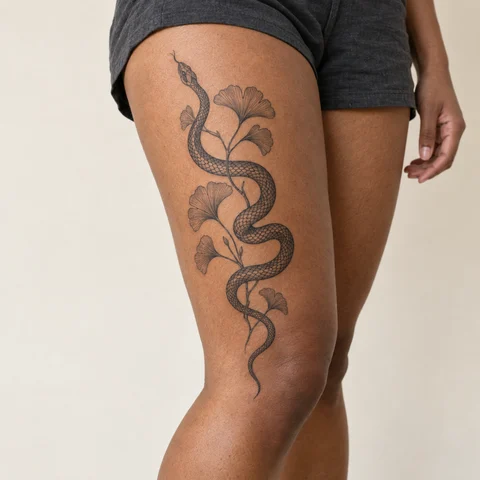
Blackwork and contrast
Dark areas and open skin define the silhouette. Review it from a distance too.
Explore this direction →Where should your tattoo go?
Visible in daily life
The wrist, forearm and hand let you look at your tattoo easily. Compare their visibility with your usual sleeves and during everyday gestures.
Revealed by your clothing
The upper arm, thigh and parts of the back can be covered depending on the outfit. Test the clothes you actually wear.
Room for a larger composition
The back, shoulder and calf offer different directions for a developing piece. Decide whether it should stand alone or connect to future tattoos.
Compare areas without a universal ranking
Write down three priorities: being able to cover the tattoo, seeing it without a mirror, or leaving space for another piece. Some priorities may conflict. A comparison is useful precisely because it makes these choices clearer.
For a long design
The forearm, calf and centre of the back offer different vertical layouts. Check the available width as well: stretching an image does not adapt it to the body.
For a rounded motif
The shoulder and thigh let you compare a flower, framed animal or rosette. Look at the outline from the front and side.
For a compact symbol
The wrist, nape and ankle provide different degrees of visibility. For a finger or hand, discuss dimensions and spacing especially carefully.
For lettering
The actual length of your text matters more than the size of a sample. One word and a full sentence may call for different placements.
Prepare a full-size placement test
Note the intended height and width, then observe a mock-up standing naturally. Photograph the whole area as well as the detail. Add a side view for rounded surfaces.
Prepare questions about clothing, daily movements, the appointment and aftercare. A body chart cannot predict your experience or result: a simulation helps you choose a visual direction, while the professional evaluates your specific project.
More directions for your project
From the first design to your appointment
Clarify your reference
Keep a few images and explain what you like about each: the subject, linework, scale or placement. A reference starts a conversation; it is not a finished stencil.
Choose an artist for the style
Look at the artist’s own work, including healed examples where available. Discuss the intended dimensions, placement and any text before requesting a quote.
Check the final drawing
Review the stencil at its actual size and in several natural positions. Read names and dates character by character before approving them.
Prepare the appointment and aftercare
Ask your tattoo artist for preparation and aftercare instructions tailored to the session. The images here cannot determine what is suitable for your individual skin.
What if your next tattoo
started with your words?
Choose a direction, change a detail and create your own reference with Encre Vive.
Create my tattooView plans and creditsYour questions answered
01Where should I put my first tattoo?
Start with visibility and a design whose size allows its details to remain distinct. Compare two areas with an artist instead of looking for a placement that suits every first tattoo.
02Where can I keep a tattoo discreet?
Check what your usual clothes cover. The upper arm, thigh or part of the back may suit you; hands and the neck can remain visible even with a tiny design.
03Should I choose the motif or placement first?
Refine them together. A detailed subject needs enough surface; a fixed placement may mean simplifying the design.
04How much should I budget?
The artist’s work, dimensions, detail and exact placement determine the quote. Bring your references and intended size, and ask what the proposal includes.
05How can I personalise a design?
Choose a reference to open the studio with its subject and style. Adapt the motif and ask your artist to prepare the final dimensions and placement.
06Are these real tattoo photographs?
These are original AI-generated simulations. They illustrate composition and placement; they do not predict the result on your skin.