Rose tattoo ideas, stems and compositionsFrom a light outline to shaded petals.
Explore rose tattoos with a single bloom, a long stem, graphic petals or a composition with a watch and dagger. Compare petal shapes, contrast and the balance of elements before personalising your reference.
More about this selection
The stem changes the proportions: straight, curved, with leaves or without. Another subject, such as a watch or bird, changes the composition and needs space. Explain which element should remain central instead of shrinking everything to fit.
Rose tattoo ideas, stems and compositions on skin
Light, medium and dark skin tones, different proportions and placements: compare how each motif sits on the body. These images are simulations created with our AI.
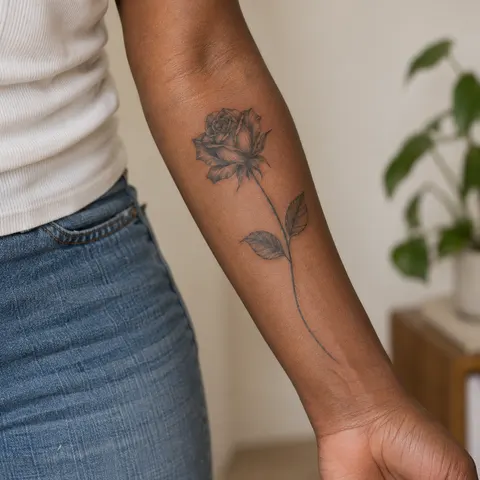
Long-stemmed rose
The stem follows the forearm. Two leaves balance the flower and leave skin visible.
PersonaliseBlack-and-grey rose
Shadows and lighter spaces define the petals: a reference to compare with a simpler floral outline.
PersonaliseGraphic rose
A strongly outlined rose sits in the centre of the hand, with distinct petals for a readable shape.
PersonaliseMore designs to explore
Try another direction: start with a line, a silhouette or a colour, then adapt the design in the studio.
An open rose on a long curved stem with two leaves
PersonaliseOne compact rose bloom without stem
PersonaliseA dagger piercing a red rose
PersonaliseAn antique pocket watch with a rose and Roman numerals
PersonaliseA swallow with a banner and a rose
PersonaliseA single stylized woman's face with closed eyes
PersonaliseTurn a reference into your own project
A rose can read as a compact outline or a flower with volume. In a graphic version, the gaps between petals define the centre. In a shaded version, grey values separate the layers. Decide what you want to recognise at first glance before adding textures.
The stem changes the proportions: straight, curved, with leaves or without. Another subject, such as a watch or bird, changes the composition and needs space. Explain which element should remain central instead of shrinking everything to fit.
Explore tattoo meanings →Three directions to compare
The main outline
Start with the outer shape. Choose what you want to keep before adding lettering or secondary elements.
Explore this direction →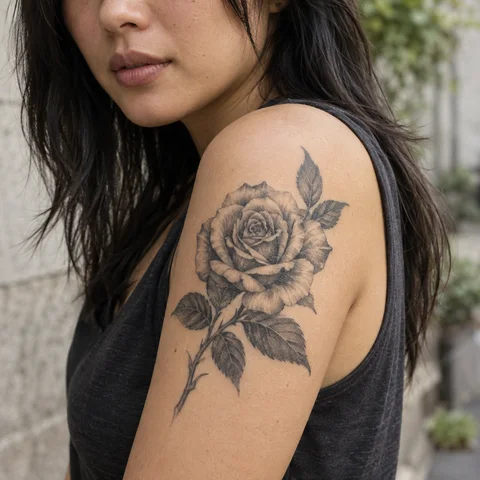
The contrast
Compare the dark lines with the open spaces. Ask your artist which details suit your intended size.
Explore this direction →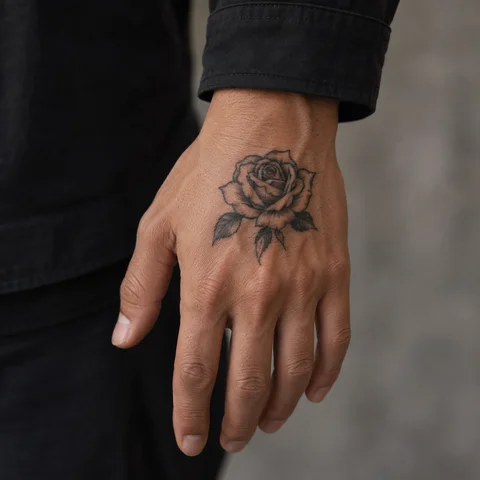
The placement
Look at the same reference at its actual size and from several angles. The placement is part of the composition.
Explore this direction →Where should your tattoo go?
Forearm
A long-stemmed rose creates an axis. Try different directions for the bloom and leaves.
Upper arm
An open flower can occupy the rounded area. Check the petals from the front and side.
Hand
A compact version helps compare outlines. Ask your artist to adapt the details to this area.
Three ways to build a rose
The flower head
Keep the centre distinct from the outer petals. Compare a rounded bloom with a three-quarter view.
The long-stemmed rose
Leaves and the curve extend the drawing. Leave room around any thorns you want to retain.
The rose with another subject
A watch, bird or portrait needs a visual hierarchy. Choose a main subject and a supporting detail.
Prepare your reference for the artist
Keep two or three references and note exactly what you want to retain from each. Specify placement, approximate dimensions and any existing tattoos nearby.
If the design includes letters or a date, prepare the exact text separately. AI images are starting points for discussion, not validated stencils or predictions of the final result.
More directions for your project
From the first design to your appointment
Clarify your reference
Keep a few images and explain what you like about each: the subject, linework, scale or placement. A reference starts a conversation; it is not a finished stencil.
Choose an artist for the style
Look at the artist’s own work, including healed examples where available. Discuss the intended dimensions, placement and any text before requesting a quote.
Check the final drawing
Review the stencil at its actual size and in several natural positions. Read names and dates character by character before approving them.
Prepare the appointment and aftercare
Ask your tattoo artist for preparation and aftercare instructions tailored to the session. The images here cannot determine what is suitable for your individual skin.
What if your next tattoo
started with your words?
Choose a direction, change a detail and create your own reference with Encre Vive.
Create my tattooView plans and creditsYour questions answered
01Does a rose have to be red?
No. Black and grey, outlines alone and colour are different directions. Compare examples of the style you want with your artist.
02Can I add a date to a rose?
Yes. A separate line below the bloom keeps the text easy to check. Verify every number and allow enough space.
03How can I simplify a small rose?
Keep the few petals that define its shape and remove secondary textures. Check readability at the actual size with your artist.
04How do I personalise a reference?
Choose a model to open the generator with its subject and style. Change the description before generating and check any letters or numbers in the result.
05Are the tattoos in the photographs real?
The photographs are AI-generated simulations. Lettering studies show example layouts; all references need adapting with a tattoo artist.
06How much should I budget?
Ask an artist for a quote based on the dimensions, placement and detail of your project. The gallery cannot determine the cost of your session.