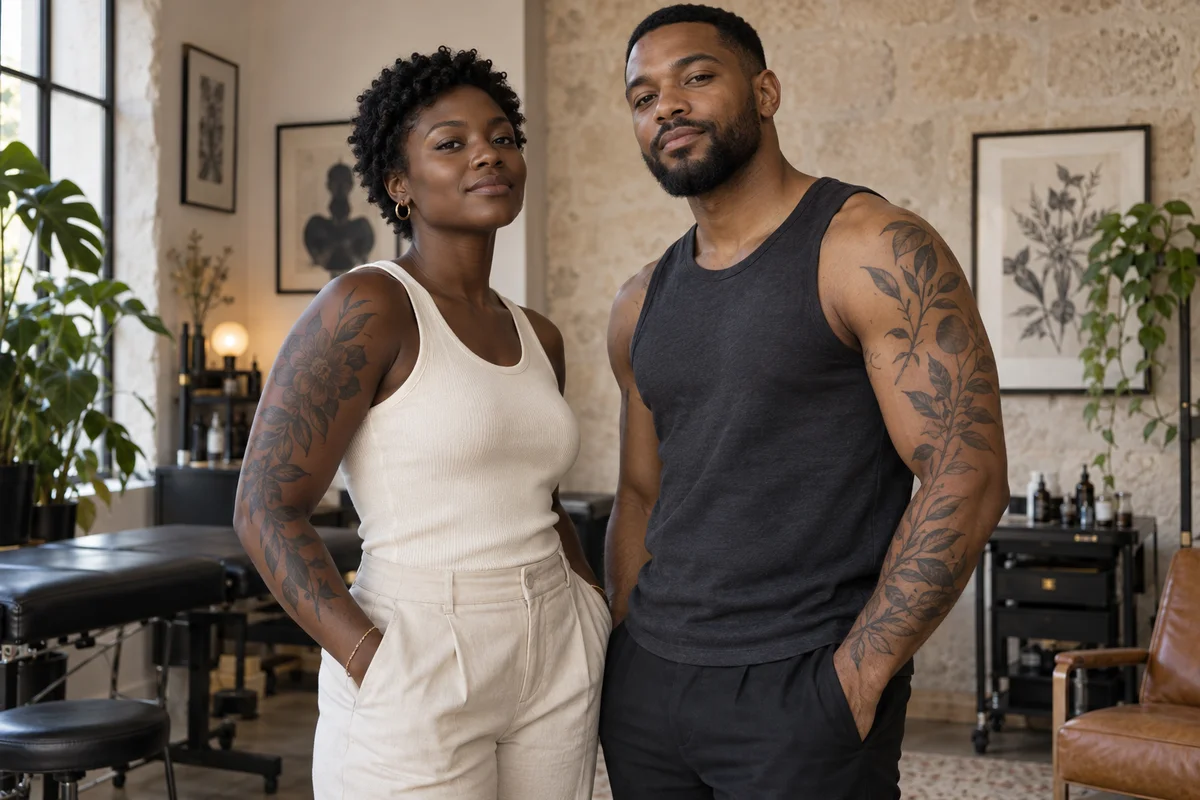
A tattoo on dark skin can be delicate, graphic, figurative or colourful. Planning starts with your skin tone, the design and your artist’s experience. There is no single “dark skin” tone, and no palette automatically suits everyone.
This guide helps you compare references and prepare for a consultation. Health information draws on the dermatology resources linked throughout the text; it does not replace advice tailored to your medical history.
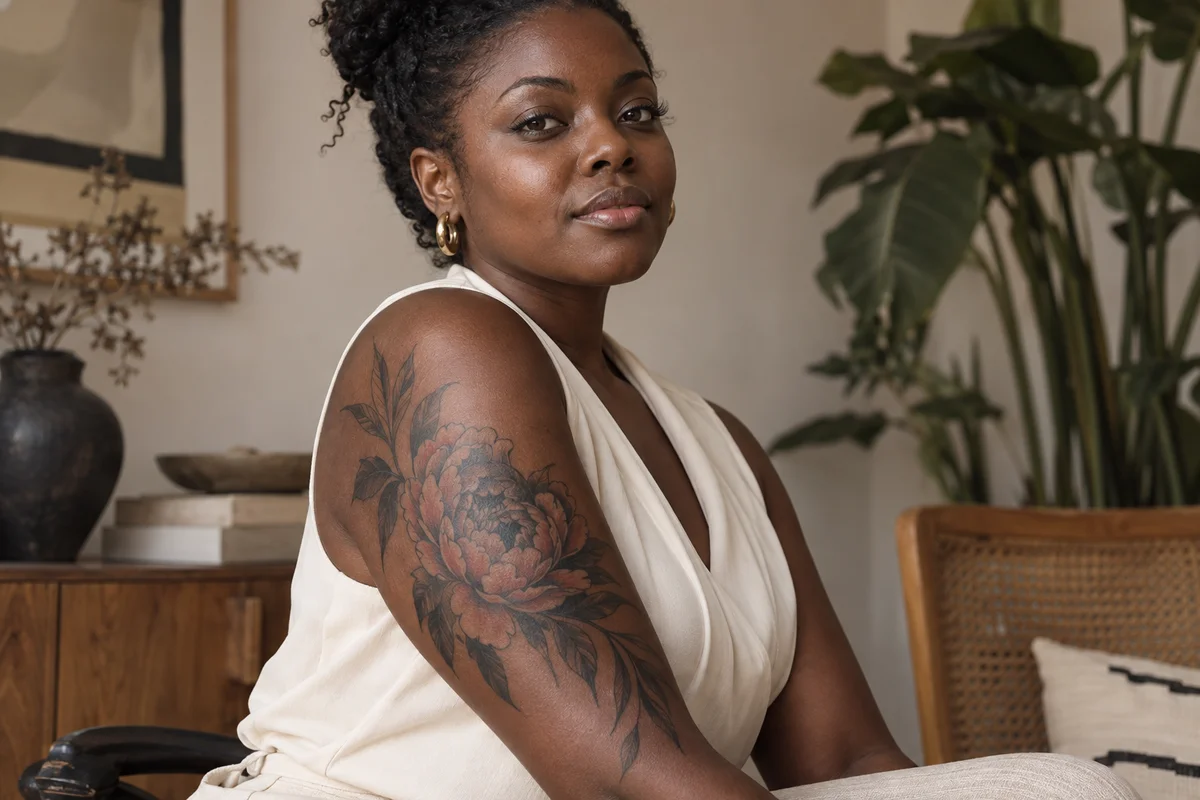
The cover and the two illustrations in this article are generated with our AI. They represent creative ideas, not real healed tattoos or a guarantee of results.
Dark skin and tattoos: start with your own skin tone
Before choosing a drawing, collect a few references you like and explain what you want to retain: a clear silhouette, a flower, geometric lines or a composition in colour. One idea can lead to several proposals. Your skin is part of the composition; it does not need to be hidden when presenting your project.
The European Academy of Dermatology and Venereology (EADV) information sheet explains that darker skin is not inherently thicker and does not always heal differently. Be wary of explanations that assign the same characteristics to everyone with dark skin.
Black, grey or colour: what are the options?
Colour tattoos are possible on dark skin. According to the EADV, their appearance varies with skin tone. Discuss the expected result with your artist rather than choosing a colour solely from an image on a screen. A palette you see on someone else is not a promise of the same result on your skin. Source: EADV information sheet on tattoos on skin of colour.
To prepare for the discussion, ask for two proposals: a black-ink composition and a colour variation. Compare which elements you want to stand out and which can be more subtle. Ask to see the proposed colours in healed work, ideally on a skin tone similar to yours.
Avoid lists claiming that a colour is always perfect or always impossible. A personalised explanation with real examples is more helpful than a blanket rule. If the artist offers a colour test, ask what it can establish: it is already a tattoo, not an erasable simulation.
Choosing a motif, size and placement
Start with a simple question: what do you want people to recognise first in your tattoo? For a flower, it might be its silhouette; for an animal, its movement; for lettering, the word itself. Ask your tattoo artist how to preserve that priority in the final drawing.
- One main motif: choose the essential element before adding a date, initials or decoration.
- A size to discuss: compare two sizes on your chosen body area using a drawing to scale.
- Space to preserve: ask which details could be simplified and where to leave skin visible.
- A considered placement: look at the composition with your arm relaxed and moving, not only in a photo pose.
Explore tattoo inspiration, then compare approaches in the tattoo styles guide. These selections help you develop your brief; they cannot determine feasibility on their own.

Choosing an artist: look at their healed work
Make a shortlist of artists whose style you like. Ask each for examples on skin tones similar to yours, specifying that you also want to see tattoos after healing. A photo taken immediately after a session answers a different question from a follow-up photo.
When comparing portfolios, prioritise clear images with lighting that lets you distinguish both the design and the skin. Ask how long ago the tattoo was done and whether it has been touched up. You do not need to assess needle technique yourself: the aim is to understand the artist’s choices.
Here are five useful questions for your consultation:
- Do you have healed examples of projects like mine on a similar skin tone?
- Which details would you change in my reference, and why?
- What size and palette would you suggest?
- What follow-up do you offer, and how do touch-ups work?
- What written instructions will I receive, and who should I contact if I have concerns?
Healing, keloids and sun exposure: what to know
Skin colour alone cannot predict how you will heal. However, tell your artist about any personal or family history of keloids, which are thick scars that extend beyond the original injury. For someone prone to them, the American Academy of Dermatology (AAD) states that avoiding tattoos is the safest way to prevent a tattoo-related keloid. Seek advice from a dermatologist before booking if this applies to you.
Ask the professional doing your tattoo to explain aftercare, dressing management and when to resume activities. Do not treat a tip from social media as a universal protocol: prepare your questions before the appointment and keep the instructions you receive.
Increasing pain, significant heat, pus or spreading inflammation require prompt medical advice; fever or chills are also warning signs. Do not wait for a touch-up appointment to seek help. Source: EADV information on tattoo infections.
Once the skin has healed, protect your tattoo from the sun. The AAD recommends broad-spectrum, water-resistant sunscreen with an SPF of at least 30, reapplied as directed. UV light can affect tattoo inks. Source: AAD, caring for tattooed skin.
Prepare your project with useful references
Write down the motif, placement, approximate size and whether you want colour. Add two or three references and explain what you like about each. Also leave room for what you do not want: heavy filling, lettering or a very symmetrical composition, for example.
An example brief: “A peony on the upper arm, with a clear silhouette and a few leaves. I would like to compare a black version with one that has touches of colour. We can decide the size together.”
The inspiration gallery can help you choose a direction. You can then create a reference with Encre Vive. An AI image explores a composition; it does not predict the colour of ink in your skin or how it will change over time. For what to expect at your appointment, see the first tattoo guide.
Frequently asked questions about tattoos on dark skin
Do I have to choose a black-ink tattoo?
No. Colour is an option to discuss with an experienced tattoo artist. Consider the palette for your own skin tone, using healed examples rather than a promise that the result will match a photo exactly.
Can I ask for a delicate design?
You can bring that idea to your artist. Ask what dimensions and spacing they recommend for your specific drawing. A style label does not replace this discussion.
Does dark skin always develop keloids?
No: keloids are not an automatic consequence of skin tone. A history of keloids does, however, warrant advice from a dermatologist before planning a tattoo.
Do these illustrations show real results?
No. The three visuals were created with our AI to illustrate compositions. To assess an artist’s work, ask for their own photographs of healed tattoos.
Dermatology sources consulted for the original guide on 22 September 2026: EADV and the American Academy of Dermatology, linked in the relevant sections. Written by the Encre Vive team; this article has not undergone individual medical review.