THE INSPIRATION NOTEBOOK
Mandala tattoo ideas: radial patterns, symmetry and placement
These references explore radial compositions: a centre, repetitions and responding spaces. They help you study an ornamental tattoo. If you start from a specific religious mandala, its context and representation need separate research.
Compare the visual references ↓Drawings and placement references
All visuals below are AI-generated creative references. Skin images are simulations, not photographs of completed or healed tattoos.
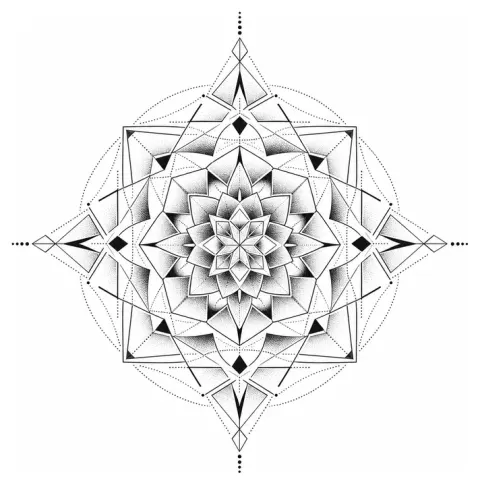
A symmetric mandala with a dotwork gradient, for the back of the shoulder
Personalise this reference →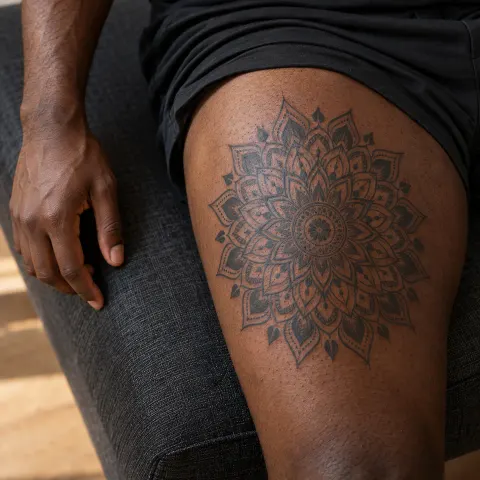
Mandala on the arm
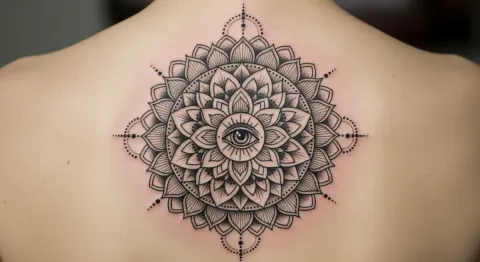
Radial mandala on skin
Three directions for your composition
A centred rosette
Decide what forms the centre and how patterns expand around it. Keep regular gaps without filling every available space.
From dotwork to outline
Dots can create a transition between layers. Compare the drawing without shading to check that the structure remains clear.
Part of a pattern
A semicircle or section can follow a body edge. Have the ending redrawn: cropping a round picture does not always create a balanced composition.
Choose the placement and scale
The shoulder and upper back can hold a broad centre. On the arm, part of the pattern wraps out of view; check repetitions with the arm relaxed. Paper symmetry and how a design looks on the body are not identical.
Compare placement on a 3D mannequin. A preview helps you discuss proportions; your artist adapts the final design to your skin.
Choose a visual language
Compare the same subject across these styles, then look for healed work in the artist’s portfolio.
A starting point for your brief
A geometric rosette with a simple centre, three spaced layers and a light dot gradient. Black ink for the rear shoulder. No lettering or added religious symbol.
Change the subject, size and details to fit your project. Keep only the elements that matter to you.
Prepare my own design →Questions before choosing
Are all circular patterns sacred mandalas?
No. A decorative rosette and a specific religious work are not interchangeable. Identify the reference if it belongs to a tradition.
Does symmetry need to look perfect on skin?
The body changes with posture. Discuss the main viewing angle and adaptation with your artist.