Moon tattoo ideasOne crescent or a sky of your own.
Explore moon tattoos with a small crescent, a sequence of phases, flowers and a sun-and-moon pairing. Compare fill, direction and spacing before choosing a simple motif or a fuller composition.
More about this selection
You can connect the moon with a memory, date or visual preference. A decorative image does not verify the phase on a particular date: check your reference if that connection matters. For a shared project, sun and moon can remain two complete drawings without requiring the same size or placement.
Moon tattoo ideas on skin
Light, medium and dark skin tones, different proportions and placements: compare how each motif sits on the body. These images are simulations created with our AI.
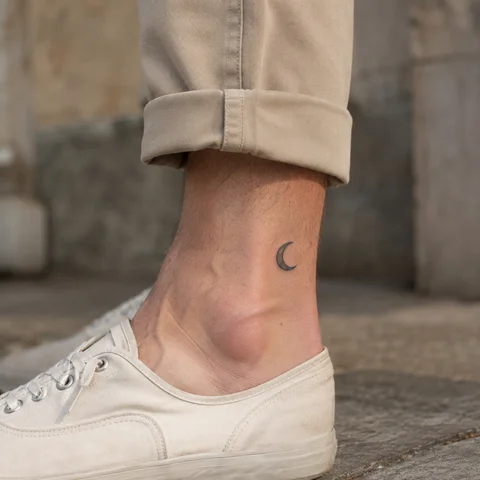
A small crescent moon
An isolated crescent at the ankle: a simple symbol whose placement is part of the project.
PersonaliseSpaced moons
A sequence of moons runs down the centre of the back. The gaps contribute as much to the rhythm as the shapes themselves.
PersonaliseFern and moon on the shoulder blade
The fern curves along the shoulder blade; the moon stays separate from the leaves.
PersonaliseMore designs to explore
Try another direction: start with a line, a silhouette or a colour, then adapt the design in the studio.
A crescent moon and three stars
PersonaliseA sprig of lavender and a chamomile flower intertwined beneath a small crescent moon
PersonaliseTwo separate coordinated small tattoo designs side by side: one simple sun and one crescent moon. Equal size and visual weight
PersonaliseTwo mountains in an open circle
PersonaliseTurn a reference into your own project
An isolated crescent keeps a compact outline. A sequence of phases uses more length and calls for regular gaps. A moon above a flower becomes part of the setting. Decide its role before adding stars: main subject, repeated rhythm or supporting detail.
You can connect the moon with a memory, date or visual preference. A decorative image does not verify the phase on a particular date: check your reference if that connection matters. For a shared project, sun and moon can remain two complete drawings without requiring the same size or placement.
Explore tattoo meanings →Three directions to compare
The main outline
Start with the outer shape. Choose what you want to keep before adding lettering or secondary elements.
Explore this direction →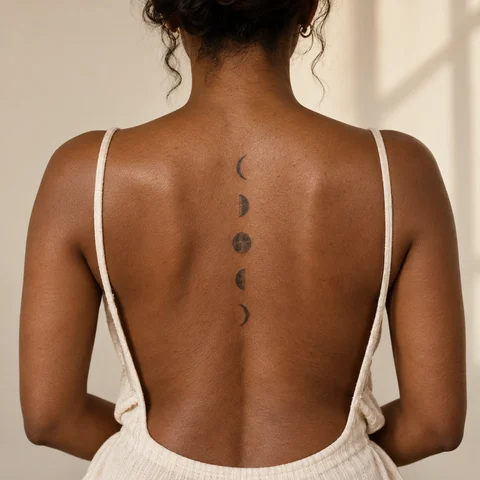
The contrast
Compare the dark lines with the open spaces. Ask your artist which details suit your intended size.
Explore this direction →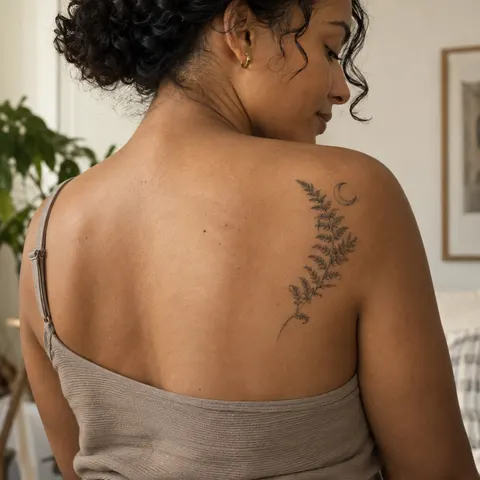
The placement
Look at the same reference at its actual size and from several angles. The placement is part of the composition.
Explore this direction →Where should your tattoo go?
Ankle
An isolated crescent is easy to compare at different sizes. Check visibility with your usual shoes.
Spine
A sequence of phases creates an axis. Check gaps and boundaries before deciding how many shapes to include.
Shoulder blade
A moon can accompany a curved branch. Keep space between the crescent and leaves.
Choose the shape before adding stars
An outlined or filled crescent
An outline and a solid shape have different contrast. Compare thickness and open space at the intended size.
A sequence of phases
Decide whether you want a decorative rhythm or an accurate astronomical representation. Check the order and direction in your reference when accuracy matters.
A moon with another subject
A flower, mountain or sun changes the focus. Keep one main element and simplify the rest if the composition becomes hard to read.
Prepare your reference for the artist
Keep two or three references and note exactly what you want to retain from each. Specify placement, approximate dimensions and any existing tattoos nearby.
If the design includes letters or a date, prepare the exact text separately. AI images are starting points for discussion, not validated stencils or predictions of the final result.
More directions for your project
From the first design to your appointment
Clarify your reference
Keep a few images and explain what you like about each: the subject, linework, scale or placement. A reference starts a conversation; it is not a finished stencil.
Choose an artist for the style
Look at the artist’s own work, including healed examples where available. Discuss the intended dimensions, placement and any text before requesting a quote.
Check the final drawing
Review the stencil at its actual size and in several natural positions. Read names and dates character by character before approving them.
Prepare the appointment and aftercare
Ask your tattoo artist for preparation and aftercare instructions tailored to the session. The images here cannot determine what is suitable for your individual skin.
What if your next tattoo
started with your words?
Choose a direction, change a detail and create your own reference with Encre Vive.
Create my tattooView plans and creditsYour questions answered
01What meaning can a moon tattoo have?
A memory, a shared occasion or an aesthetic preference can be enough. Meaning depends on your reference and story; no universal interpretation is required.
02Can I depict the moon on a particular date?
That can be your intention, but verify the phase and reference independently of the AI image. The generator is not an astronomical calendar.
03How should we plan a sun-and-moon pair?
Compare the line style and contrast of both drawings. Each person can choose their size and placement; you should also enjoy the designs separately.
04How do I personalise a reference?
Choose a model to open the generator with its subject and style. Change the description before generating and check any letters or numbers in the result.
05Are the tattoos in the photographs real?
The photographs are AI-generated simulations. Lettering studies show example layouts; all references need adapting with a tattoo artist.
06How much should I budget?
Ask an artist for a quote based on the dimensions, placement and detail of your project. The gallery cannot determine the cost of your session.