Thigh tattoo ideasFrom one piece to a larger composition.
Explore thigh tattoos with a botanical snake, peony and mandala. Compare a vertical composition with a centred motif, then decide whether it belongs on the front or outer thigh.
More about this selection
A large area does not require a large tattoo. An isolated piece can have a deliberate boundary. If you may extend towards the knee or hip, explain that during preparation so curves and spacing can support the future project.
Thigh tattoo ideas on skin
Light, medium and dark skin tones, different proportions and placements: compare how each motif sits on the body. These images are simulations created with our AI.
Snake and ginkgo
A winding silhouette moves between fan-shaped leaves. Open spaces separate the curves along the outer thigh.
PersonalisePeony and butterfly
A large flower and a lighter detail share the area while leaving space between the petals.
PersonaliseOrnamental mandala
Repetition builds a centred pattern. Contrast and the gaps between petals matter as much as detail.
PersonaliseMore designs to explore
Try another direction: start with a line, a silhouette or a colour, then adapt the design in the studio.
A hannya mask surrounded by peonies and maple leaves
PersonaliseA single stylized woman's face with closed eyes
PersonaliseA snake coiled through peonies
PersonaliseA symmetric mandala with a dotwork gradient
PersonaliseA violet iris with a long stem and small touches of blue and pink
PersonaliseA death's-head hawkmoth
PersonaliseOrganise the subject before filling the surface
The thigh gives you room to separate a main subject, supporting elements and open skin. A snake leads the eye vertically; an open flower or mandala establishes a centre. Choose this structure before detailing the petals or scales.
A large area does not require a large tattoo. An isolated piece can have a deliberate boundary. If you may extend towards the knee or hip, explain that during preparation so curves and spacing can support the future project.
Explore tattoo meanings →Three directions to compare
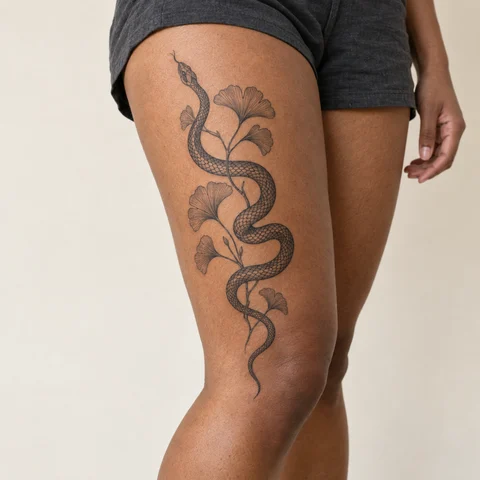
Blackwork and contrast
Dark areas and open skin define the silhouette. Review it from a distance too.
Explore this direction →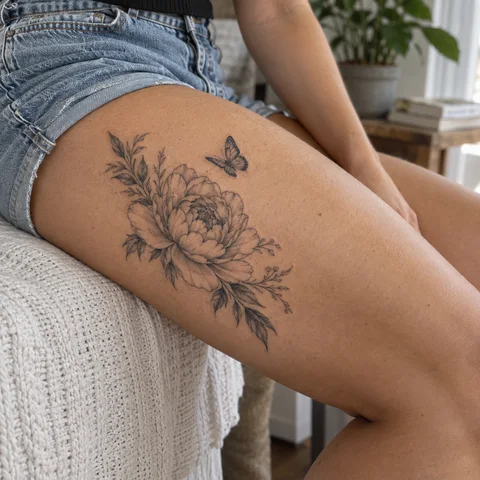
Fine lines and open space
Compare the main outline and the gaps between lines at the intended size.
Explore this direction →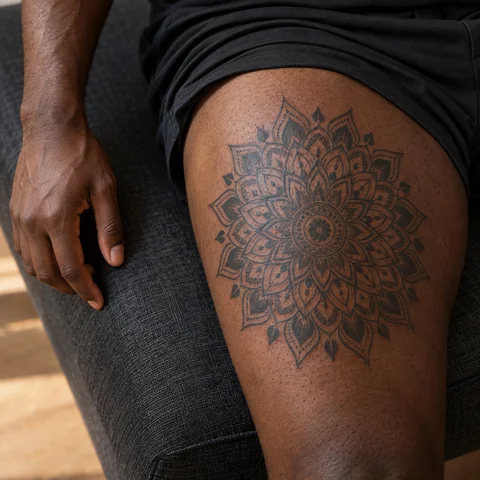
Geometry and rhythm
The centre, repeated shapes and spacing give the design structure. Review them on the body.
Explore this direction →Where should your tattoo go?
Front of the thigh
A rosette or framed subject can create a frontal focal point. Compare its appearance standing and sitting.
Outer thigh
A stem, snake or diagonal layout can follow the leg. Check which elements wrap out of view around the side.
Upper thigh
Visibility depends on shorts and other clothing. Mark the intended boundary with a usual outfit and leave room around the drawing.
Choose the scale without losing the subject
A standalone motif
Keep a clear silhouette and a deliberate edge. You do not need to fill the surrounding space to justify the placement.
A floral composition
One main bloom and a few leaves organise the volume. Varying their sizes creates a clearer hierarchy than repeating identical flowers.
An illustrated scene
A mask, snake or portrait can share the surface with a setting. Define what should read from a distance and what appears up close.
Define the boundaries of a larger piece
Bring standing front and side photographs alongside your style references. Ask about the scope of the quote and any stages of work. A large image alone does not establish the duration of a session.
Leave considered space near existing tattoos and the knee. If the piece should remain covered, check the hem of your clothes in different positions rather than only standing at a mirror.
More directions for your project
From the first design to your appointment
Clarify your reference
Keep a few images and explain what you like about each: the subject, linework, scale or placement. A reference starts a conversation; it is not a finished stencil.
Choose an artist for the style
Look at the artist’s own work, including healed examples where available. Discuss the intended dimensions, placement and any text before requesting a quote.
Check the final drawing
Review the stencil at its actual size and in several natural positions. Read names and dates character by character before approving them.
Prepare the appointment and aftercare
Ask your tattoo artist for preparation and aftercare instructions tailored to the session. The images here cannot determine what is suitable for your individual skin.
What if your next tattoo
started with your words?
Choose a direction, change a detail and create your own reference with Encre Vive.
Create my tattooView plans and creditsYour questions answered
01Does a thigh tattoo need to be large?
No. A small piece can be deliberately isolated. Choose dimensions for the drawing and its detail, then compare the space around it.
02Front or outer thigh?
The front provides a frontal view; the side suits a profile view or wrapping composition. Compare both using a full-size stencil.
03Can a thigh tattoo extend towards the calf?
A leg project can connect several areas. Plan the passage around the knee and the transitions with your artist.
04How much should I budget?
The artist’s work, dimensions, detail and exact placement determine the quote. Bring your references and intended size, and ask what the proposal includes.
05How can I personalise a design?
Choose a reference to open the studio with its subject and style. Adapt the motif and ask your artist to prepare the final dimensions and placement.
06Are these real tattoo photographs?
These are original AI-generated simulations. They illustrate composition and placement; they do not predict the result on your skin.