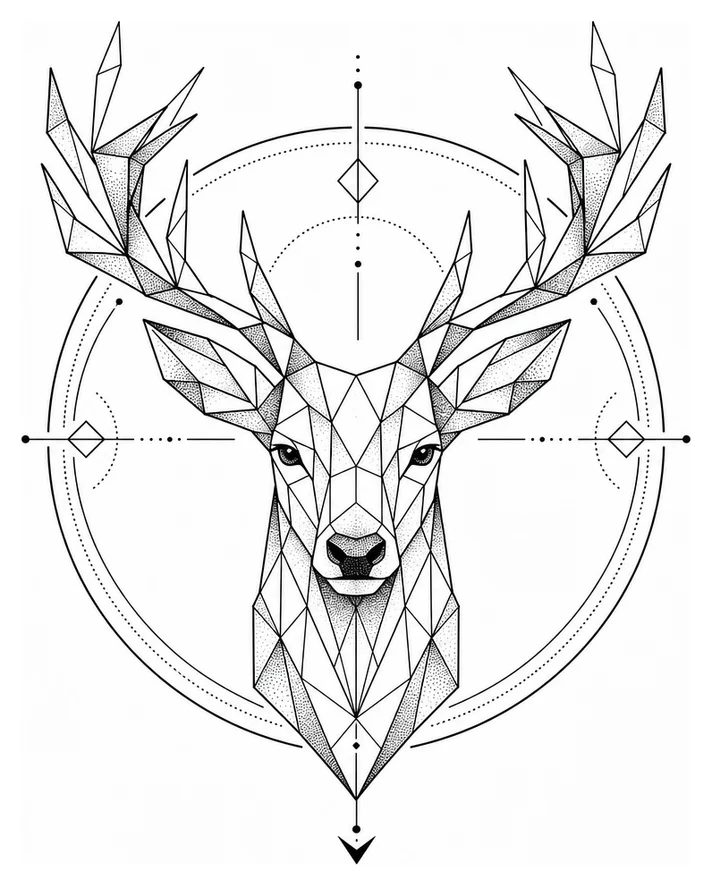
A deer may express a connection with woodland, quiet attention or a search for calm. Antlers give the drawing a strong shape without imposing a meaning of power. Landscape, gaze and movement help explain what the animal means to you.
The illustration is an AI-generated creative reference, not a photograph of a completed tattoo.
Woodland as a memory
Instead of adding a generic forest, choose a meaningful detail: an edge of trees, a slope or a particular branch. Keep the deer prominent and let the landscape act as a subtle reference. If the memory is a moment of encounter, a portrait may be enough.
Antlers need not become a crown
A frontal drawing emphasises symmetry; a three-quarter view gives the gaze a different role. Check the branches and gaps between them. Geometry can simplify that structure, but too many triangles and dots may hide the animal.
Choose an attitude
A still deer can suggest listening, while a walking animal introduces direction. You can express sensitivity without adding signs of weakness or dominance. Describe a concrete posture: a lowered head, a sideways glance or a slow step.
Allow room for the silhouette
On a calf or forearm, antlers often need more width than the muzzle. Consider the whole composition instead of shrinking only its upper section. At a small size, a simplified profile may preserve your intention better than a portrait crowded with branches.
From meaning to a drawing
Keep a short brief with the subject, the element that matters to you and what you want to leave out. Explore a personal design reference, then discuss its adaptation with your tattoo artist.
Compare related projects : Calf · Forearm.
Questions about this motif
Does a geometric deer have a different meaning?
Geometry mainly changes the visual language. The same memory or intention can remain while lines and open spaces take a larger role.

Geometric
Axes, circles and facets organise the composition.
Neo-Traditional
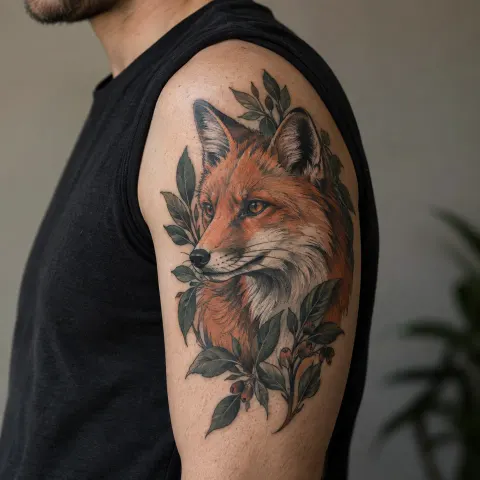
Defined outlines and a richly shaded colour palette.